

Analysis of Carbon Brief’s Cosmos database reveals the world’s leading “institutions” for climate research.
There are more than 40,000 institutions in the Cosmos database, ranging from universities and research laboratories, through to policy institutes and governmental bodies.
Carbon Brief has given each institution a “publication count”, by adding up the number of times that its experts appear in the author list of studies in the Cosmos database.
This analysis has allowed Carbon Brief to identify the 500 institutions with the highest publication count – as part of the Cosmos 500 rankings, which also includes authors and publications.
More than one third of institutions in the ranking are based in the US, underscoring the threat currently posed by the Trump administration’s attacks on climate science.
Meanwhile, there are only 30 institutions from global south countries in the Cosmos 500, around half of which are in China.

The
top five
The “publication count” metric is based on the number of publications linked to an institution, based on author affiliations when a study was published.
For this, Carbon Brief used OpenAlex, an open-source catalogue of millions of academic books, studies and reports.
Often, a parent institution is linked to a group of subsidiary organisations. For example, the University of London encompasses a range of institutions including University College London, King’s College London and the London School of Economics.
Carbon Brief uses the definition of institutions provided by OpenAlex.
(The method section below explains how Carbon Brief has scored the institutions in more detail.)
French National Centre for Scientific Research

Topping the Cosmos 500 ranking is the French National Centre for Scientific Research (Centre National de la Recherche Scientifique, CNRS), with a publication count of 864,154.
The organisation, established in 1939, is “active in all scientific fields” and employs almost 30,000 scientists in France and abroad.
Its main hubs for climate science include the National Institute of Sciences of the Universe, the Institute of Ecology and Environment and the Climate and Environment Sciences Laboratory.
Many of these hubs are also listed separately in the Cosmos 500. For example, the Climate and Environment Sciences Laboratory ranks 40th.
CNRS has more than 20 scientists in the Cosmos 500 ranking of the most highly cited authors, including Prof Philippe Ciais – the highest ranking author in the Cosmos database – as well as Dr Oliviér Boucher and Dr Wilfried Thuiller.
NSF National Center for Atmospheric Research


In second place is the National Center for Atmospheric Research (NCAR) – a federally funded research and development centre headquartered in Colorado, US – with a score of 721,372.
The organisation describes itself as a “global leader in Earth system science”. It manages multiple facilities, including the Mesa Laboratory in Colorado and the Mauna Loa Solar Observatory in Hawaii.
The organisation has more than 60 scientists in the Cosmos 500 ranking of the most highly cited authors, including Dr Gerald Meehl and Dr Jean‐François Lamarque. It was founded in 1960.
University of Washington


The University of Washington is the third most highly cited organisation in Carbon Brief’s ranking, with a score of 662,032.
Its main divisions centred on climate change include the programme on climate change, the climate impacts group and the department of atmospheric and climate science.
The university was established in 1861. It has more than 25 scientists in its Cosmos 500 ranking of the most highly cited authors, including Prof John Wallace and Prof Chris Bretherton.
Chinese Academy of Sciences

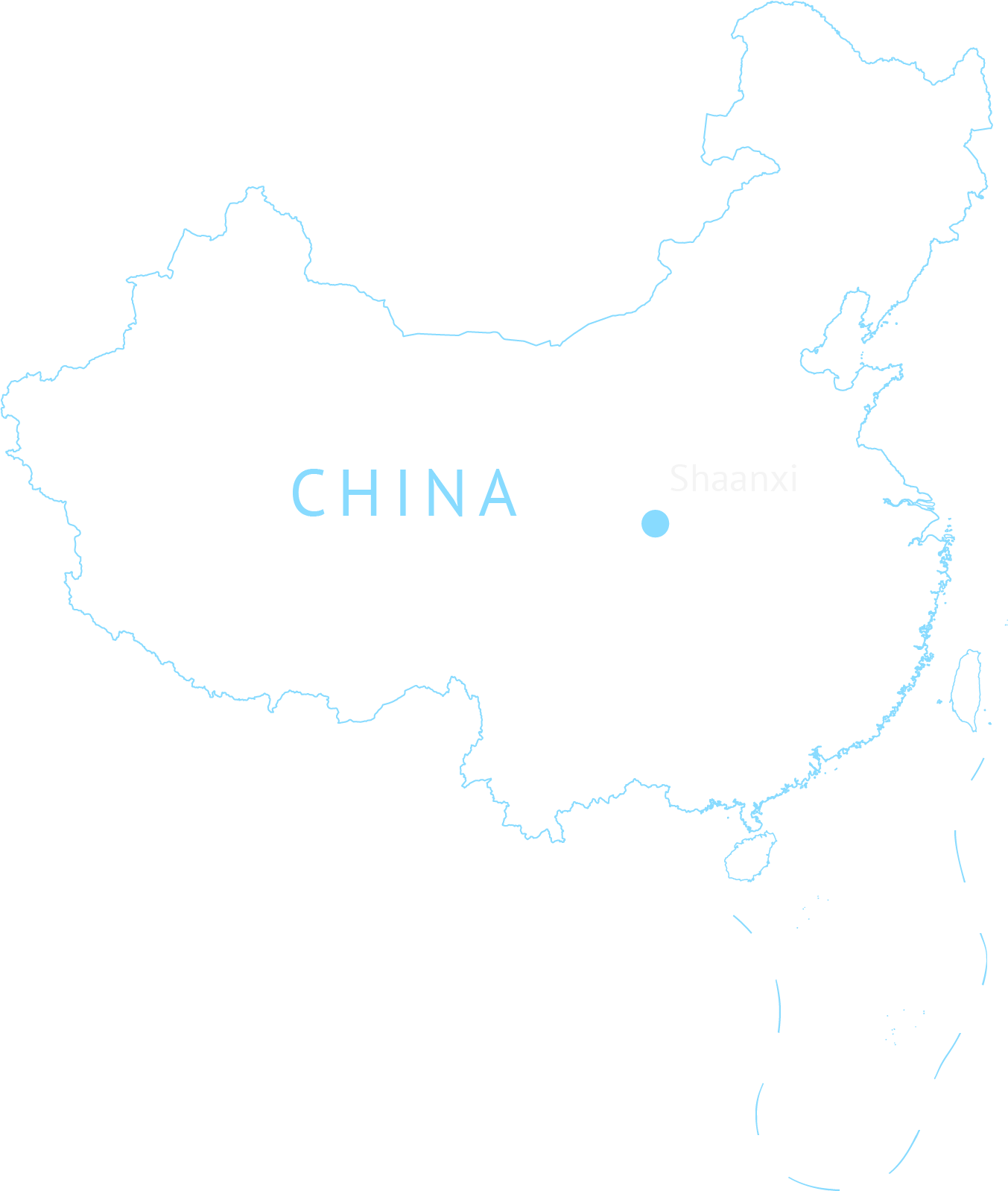
The Chinese Academy of Sciences (CAS) takes fourth place, with a score of 530,244. According to Nature, it is the world’s largest research organisation. It was established in 1949, contains 106 research institutes and boasts more than 70,000 full-time employees.
The Institute of Atmospheric Physics and the Institute of Earth Environment are among the key climate science bodies at CAS. These are ranked, separately, at 107 and 439 in the Cosmos 500.
The Cosmos 500 ranking features CAS scientists including Dr An Zhisheng and Dr Tianjun Zhou.
In total, there are only 30 institutions from global south countries in the Cosmos 500 ranking. Half of these are in China.
Columbia University

In fifth place is New York’s Columbia University, with a score of 505,465. The organisation was established in 1754, making it the fifth-oldest institution of higher education in the US.
Much of the university’s climate change research is conducted through the Lamont-Doherty Earth Observatory, which was launched in 1949.
The Cosmos 500 ranking features scientists from Columbia University such as Prof Richard Seager and Dr Gavin Schmidt.
Rest of the top 20
6. NASA’s Goddard Space Flight Centre (GSFC), founded in 1959, is sixth in the Cosmos 500 ranking. The organisation, which is based in Maryland, focuses its research on using observations from space to increase knowledge of the Earth, the solar system and the universe.
The Goddard Institute for Space Studies (GISS) sits within the Earth Sciences Division of the GSFC. This is ranked separately in the Cosmos database, coming in at position 87.
7. Ranking seventh is University of California, Berkeley – the founding campus of the University of California system, which was established in 1868. This is one of the 10 campuses that together make up the University of California.
Others include UC Davis, UC Santa Barbara and UC San Diego, which rank – separately – at positions 36, 37 and 44, respectively, in the Cosmos 500.
Climate change research at the institution is mainly coordinated by the Berkeley Climate Change Network.
8. In eighth place is the University of Colorado, Boulder – the first campus in the University of Colorado, which is made up of four campuses. The campus was founded in 1876.
The University of Colorado, Boulder, formed a partnership with NOAA to create the Cooperative Institute for Research in Environmental Sciences (CIRES) in 1967. This institute ranks 45th in the Cosmos ranking and hosts crucial research centres, such as the National Snow and Ice Data Center (NSIDC).
(Note that the University of Colorado, Boulder, is separate from NCAR, although the two institutions have collaborated closely on climate change research.)
9. The US Geological Survey (USGS), which forms part of the US Department of the Interior, takes the ninth spot on Carbon Brief’s Cosmos 500.
Its website says: ”The USGS began in 1879 to study the nation’s lands and resources. Today, we monitor, analyse, and predict Earth’s changing systems.”
10. Rounding out the top 10 is Stanford University in California, with a score of 407,969.
Making up the rest of the top-20 institutions in the Cosmos 500 are:
- The National Oceanic and Atmospheric Administration (NOAA), US
- The University of Oxford, UK
- Harvard University, US
- Princeton University, US
- The Met Office, UK
- The University of Wisconsin-Madison, US
- The University of Maryland, US
- ETH Zurich, Switzerland
- The University of East Anglia, UK
- Wageningen University & Research, The Netherlands
IPCC-only database
Carbon Brief has also analysed the 107,000 unique studies, reports and books that are directly referenced in the IPCC reports. This subset of data is known as the “IPCC-only” section of the Cosmos database.
There is a high level of overlap between the main Cosmos 500 ranking and the IPCC-only ranking.
In the IPCC-only ranking, the NSF National Center for Atmospheric Research comes in first place. CNRS comes second and in third place is the Met Office (UK).
US dominance
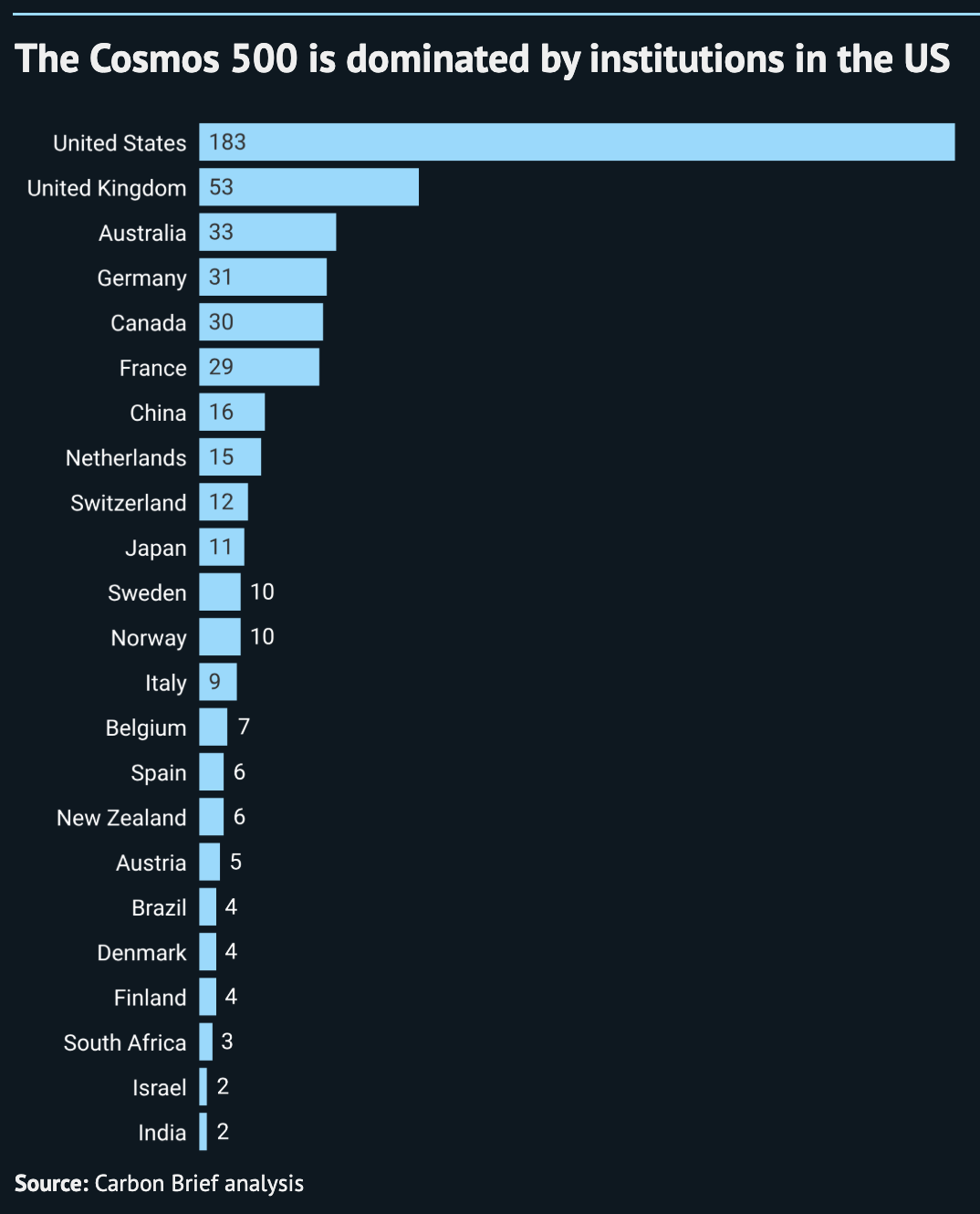
Carbon Brief’s Cosmos 500 ranking shows how institutions and scientists in the US are a cornerstone of climate science. The ranking reveals that 183 institutions in the Cosmos 500 ranking – as well as 13 of the top 20 – are based in the US.
The UK is next in the ranking, with 53 institutions in the Cosmos 500. Australia and Germany take third and fourth place with 33 and 31 institutions each, closely followed by France and Canada with 30 and 29, respectively.
The plot below shows that the Cosmos 500 is dominated by institutions from the US.
While US institutions have been seen as global leaders on climate research for decades, they have been threatened by funding cuts and political interference under the Trump administration, with US climate scientists and their research coming under attack.
For example, in the spring of 2025, hundreds of staff members at NOAA – which ranks 11th in the Cosmos 500 – were fired. The move came amid a push from the so-called “Department of Government Efficiency”, or DOGE, to cut costs.
In April 2025, the Trump administration dismissed all contributors to the sixth US national climate assessment over email. The Guardian noted that nearly 400 scientists and other experts were listed as authors on the report, which has been published routinely since the year 2000 and is “used by federal and local governments to understand how to prepare for climate crisis impacts”.
In March 2026, the New York Times reported that an estimated 95,000 employees “have left federal science agencies through layoffs, retirements or resignations since Mr Trump returned to the White House last year”.
The rankings
Methodology
To produce these rankings, Carbon Brief defined a metric called the “publication count”. This is the number of times that experts from each institution appear in the author list of publications in the Cosmos universe.
Carbon Brief has used OpenAlex to identify which institution each author was affiliated with at the time their research was published.
Each institution represented on a publication equates to one point. For example, if a study lists five authors from the University of Washington and two from Columbia University, both institutions each receive one point.
To get the final ranking, Carbon Brief has added up all the publication counts of each institution.
Often, a parent institution is linked to a group of subsidiary organisations. For example, the University of London encompasses a range of institutions including University College London, King’s College London and the London School of Economics.
Carbon Brief uses the definition of institutions given by OpenAlex and acknowledges that there may be inconsistencies in its classifications.
Please note: The designations employed and the presentation of the material on this map do not imply the expression of any opinion whatsoever on the part of Carbon Brief concerning the legal status of any country, territory, city or area or of its authorities, or concerning the delimitation of its frontiers or boundaries.