
Detlef van Vuuren is one of the world’s leading climate modellers. He has been involved in coordinating several key modelling exercises, with one high-profile emissions scenario – “RCP8.5” – being recently targeted as “wrong, wrong, wrong” by Donald Trump.
Speaking to Carbon Brief at his office in the Hague, Van Vuuren cuts a serious, but relaxed figure – despite, momentarily, being caught in the white heat of global media attention following the social-media post by the climate-sceptic US president.
Leading a team of modellers at PBL Netherlands Environmental Assessment Agency in the Dutch administrative capital, Van Vuuren also holds a professorship at the faculty of geosciences at Utrecht University.
Analysis of Carbon Brief’s Cosmos database reveals that, out of many thousands of researchers, he is the author most cited within all the reports published by the Intergovernmental Panel on Climate Change (IPCC) since 1990.
In a wide-ranging interview, he discusses:
- Why climate modelling is so important.
- The “choice” now facing China.
- What keeps him up at night.
- The 1992 book that first inspired him to work on climate change.
1989-1995: Utrecht University, masters (environmental science & chemistry)
1990-1991: Leiden University, public administration science
1996-2000: National Institute for Public Health and the Environment
2000-present: PBL Netherlands Environmental Assessment Agency
2007: PhD, “Energy systems and climate policy – long-term scenarios for an uncertain future.”
2011-present: Utrecht University, professor of integrated assessment of global environmental change
2015-present: PBL, project leader of IMAGE integrated assessment team
2019-2022: IPCC AR6 WG3, leading author
2020-2023: IPCC AR6 synthesis report, core writing team
Other highlights include:
On Donald Trump posting about the RCP8.5 emissions scenario:
“The fact that we now are not considering that high-emission scenario anymore was an easy target for those people that have an interest in no climate policy.”
On whether the temperature rise associated with RCP8.5 can now be ruled out:
“No…because that also depends on climate sensitivity. It also depends on carbon-cycle feedbacks and we still have to research that.”
On the new high-emissions scenario:
“By 2150, actually, [it] will lead to similar forcing levels as the old RCP8.5. It's simply delayed, but it could still happen.”
On whether models are to blame for inaction:
“It's not the fault of the models that we need quite a large amount of negative emissions to achieve the Paris goals, it's the fault of our inaction.”
On tipping points:
“Yes, I think one of the major things that these models don't describe is some of the possible tipping points that could happen…Overall, they're much better at looking into smooth trajectories than they are considering real tipping points.”
On climate scientists being used in court cases:
“I do find it difficult, because we're not necessarily exactly equipped as scientists in this role. At the same time, unfortunately, it's a consequence of our governments not acting fast enough.”
On being depressed about climate change:
“As climate scientists, it is relatively easy to get relatively depressed about what is happening in the world. We have been pointing out already for so long that, first of all, the current trajectory is completely unattractive…and, still, we are still not making that progress.”
Interview transcript in full
Carbon Brief: Thank you for taking the time to speak with Carbon Brief today here in The Hague at the Netherlands Environmental Assessment Agency. We are here because our analysis of our new Cosmos database of climate studies is showing that you are the most highly cited scientist across all of the IPCC reports ever published. So can we begin with you explaining, in very simple terms, what your research focuses on, so we can all get a better understanding of why it’s had such an impact.
Detlef van Vuuren: Yes. So, I’ve been working on scenarios of global environmental change – of climate change, in particular. So, when I started my career, those were mostly energy scenarios related to emissions. Around 2010, there was a need to renew the community scenarios and I’ve been heavily involved in that activity. And so I’ve been, since then, working on these community scenarios. And, yes, obviously they are used a lot in [climate] research, which makes it easier also, I guess, to become highly cited.
CB: By “community”, you mean the community of climate modellers and analysts and scientists around the world, which is quite a big community, right?
DV: Yes, exactly. So, climate change automatically is about the future. And it’s about the future because climate impacts and climate change is happening slowly over time. It’s also because climate policy is not happening from today to tomorrow. And so we need scenarios to explore how the future might evolve.
And we can do that all on our own, we can all develop our own scenarios, but that doesn’t help. And then the literature becomes very scattered. And so, in addition to simply focused scenarios for particular research, we develop these community scenarios, which links the different research groups. And it also means that we don’t have to do everything ourselves. And, so, we can ask somebody to develop, first of all, a population scenario that can be then used by people looking into energy systems, and land-use systems, and see what consequences that has for emissions. Then we can ask the climate-modelling teams to run those and make projections about climate change and these can then be used by impact researchers.
So we have a relay system where we all can contribute and this is helpful also because, by running similar scenarios, we not only can use that information, but we can also get some idea of the uncertainties. So, different modelling teams running the same scenario and give us a spread. And so that’s why we have these community scenarios and we update them more or less every eight years or so.
CB: And what is your particular specialism? You talk about the community and how you all kind of work together and you establish certain agreement over, and you share certain tools, etc, but what is your particular specialism?
DV: Yeah, so I’m working on integrated assessment, which is trying to develop scenarios, first of all, for energy and land use, and then also for emissions. In our model, which is called IMAGE, we also look into how that changes the climate and how that, by itself, leads to feedbacks [in] the carbon cycle and then try to develop integrated scenarios of global environmental change – mostly on climate change, but also having a few [looking at] what does it mean, for instance, for land use and biodiversity. And, so, I’ve been working on scenarios, integrated scenarios, all my career.
CB: And why do you think you are most highly cited in our analysis of the IPCC reports? What is your key role? I know you’ve been an IPCC author – and we’ll talk about the IPCC itself a little bit later – but why do you think you come out top on this kind of citation analysis?
DV: So, I think the integrated assessment analysis that we do ourselves is very interesting, and I think it’s good work, but that would not have made me on top of the list. It’s mostly the work that we do on the community scenarios, because they automatically need to be cited by everybody, that makes me high on this list.
Around 2010, we originally had a set of scenarios that was called the SRES scenarios and that stands for “special report on emissions scenarios”. At that time, there were a lot of new things that could be done. So, we first of all needed a new set of scenarios, but, for the first time, we also had these Earth-system models that could take up land-use preference. We had the ability to also really bring in atmospheric pollution scenarios. And so, around this time of 2010, when we developed the RCPs [representative concentration pathways], we really had the opportunity to work with the whole community and create a very novel set of scenarios. And I think that has created quite a bit of contention since – and I coordinated that exercise a bit.
CB: So, talking of citations, probably the most extraordinary citation of all is the recent citation by the US president – or whoever controls his social-media accounts these days – when he publicly commented on RCP8.5 saying it is: “Wrong, wrong, wrong.” [See Carbon Brief’s factcheck: “Trump’s false claims about the IPCC and ‘RCP8.5’ climate scenario.”] How did that make you feel to see the world’s most powerful person directly attacking a key focus of your life’s work?
DV: Yes. So, what we see here is how climate change is related to interests. So, what we were considering now, in 202[6], is what are now new relevant scenarios. And there were good reasons, and we might speak about it, why we now are not using the old high-emission scenario. And, yes, that can be spun. So, the fact that we now are not considering that high-emission scenario anymore was an easy target for those people that have an interest in no climate policy to say: “Hey, look at this. These researchers were using this high-emission scenario. They now dropped it. They have been fooling us for a long time.” And, yes, so that was what was happening. It’s completely not true, but that is, I think, behind that tweet [by Donald Trump].
CB: So, let’s look at that a little bit more. It seems that Donald Trump’s post was sort of triggered by you saying in a recent paper that RCP8.5 – and its subsequent updates in the decade since – is no longer plausible. The word “plausible” has seemed to have been the thing that has caught attention – hence, it is being “retired”, or, as you say, not used anymore in the modelling. What are your wider reflections about RCP8.5 and related scenarios and how they’ve been portrayed in parts of the media and in the kind of online space? What have the critics got wrong and what have they got right around this?
DV: So, the scenarios are not predictions of the future. Scenarios are a way to explore different possible pathways. And we simply do not know the future, partly because there is uncertainty, but partly because there’s human choice. And that means that none of these scenarios are going to describe what is going to happen, but possible pathways that could happen. And they are, therefore, relevant for certain questions. And so when we made the scenarios around 2010, one relevant question is: what is maybe a pathway that is consistent with current trends? And, so, then you get a middle scenario. And, unfortunately, that is a scenario where we see greenhouse gas emissions going up and climate change getting worse.
But there are other relevant questions there as well. So, one was what would be needed if we want to stay well below 2C? And, so, we had a scenario in that context. But it is just as relevant also to consider can things be worse?
I live in the Netherlands. My country is obviously threatened by sea level rise. I don’t want my government only to have a look at the best-guess climate change. I also want that government to consider that maybe things can be worse and how high do the dikes [flood protection] have to be and when do we have to prepare for that? And so, in that whole set, there was also this high-emission scenario. So, low probability, but high impact – and that scenario was called RCP8.5, because it was leading, by the end of the century to eight and a half…
CB: 8.5 doesn’t refer to temperature, right? That refers to the watts per square metre…
DV: Exactly…
CB: …you can explain.
DV: So, by the end of the century, the radiative forcing, which is the amount of energy that greenhouse gases put into the atmosphere, would be 8.5 watts per square metre. So there’s an additional forcing created by greenhouse gases. And that’s really high, because that would be consistent with a warming that would be somewhere between 4C and 5C by the end of the century.
So that scenario was never the most-likely scenario. It was a scenario that was consistent with high population growth, a rapid increase also in coal use, but it was consistent with other high-emission scenarios around that time. So it was also obviously the time where emissions in China went up pretty fast driven by coal. And, so, this was, at that time, really considered to be a plausible case.
And we’re now 15 years down the road and we have actually followed the medium scenario. And, so, if we now have to reconsider what is possible, then that original scenario when we went off is obviously not something that you can, that is…
CB: …the 8.5 forcing is still plausible, but it’s just the scenario you imagined 10, 15 years ago, with lots of coal and high population, etc, that’s not plausible? Is that right? Or could we still have that level of forcing, it just might be a different scenario that might lead to that level?
DV: So, we’re now 15 years down the road and emissions have, since then, followed the medium pathway. And, so, while we were creating a funnel of possible scenarios in 2010, we now have to create a new funnel around 202[6]. What would now be a relevant high-emission scenario? And, obviously, for 15 years we have not followed that high scenario, we have followed a medium pathway. And it does mean that, even if you now would create a new scenario with the same rapid increase in emissions, it would always be below that original RCP8.5.
And so, therefore, it’s already unlikely that you would end up in 2100 with the same greenhouse gas concentrations as you would have in that RCP8.5 that was relevant in 2010. And, so, the answer is no. If we follow a new high-emission scenario, it’s very likely to have less radiative forcing by the end of the century than the RCP8.5.
And then, in addition, things happened. We had some climate policy which has stimulated the cost decline of renewables and that also means that it’s maybe less likely that fossil fuels go up as fast as they originally did. And so, all in all, it means that the original emission pathway by now is not a logical one anymore and so we now have created a new high-emission scenario.
Does it mean that the temperature of the original RCP8.5 could not happen anymore? No, it does not, because that also depends on climate sensitivity. It also depends on carbon-cycle feedbacks and we still have to research that. So these emission scenarios now go to climate models and they will have a look at what are the possible consequences.
CB: OK, so that feels important, right? So even though the RCP8.5 emission scenario might now be implausible – that were imagined 10, 15 years ago – scientists still need to assess and work out what the impact of an equivalent temperature rise globally that could have happened because we need to, as you say, you need to stress-test and prepare for the worst-case scenarios and understand what the climate impacts might be on crops or sea level rise. So, there is still a system within the modelling community for assessing those very high temperature rises that may have been equivalent to RCP8.5. It’s just that the imagined emission scenario that would have got you there is now implausible, but there are still other potential low-probability, but high-risk situations around such extreme temperature rise within the century?
DV: So, I think there are three things that we need to consider here. The first of all: the fact that this emission scenario now is 15 years delayed means that we will not likely get to the same greenhouse gas concentrations as RCP8.5, but it would still be rising around 2100.
And so, by 2150, actually, even the new high scenario will lead to similar forcing levels as the old RCP8.5. It’s simply delayed, but it could still happen.
Then, second, there’s this uncertainty in the climate system. It’s not only emissions that are uncertain, but also the climate system. And we can explore that by simple climate models that could potentially explore high-climate-sensitivity cases. But we also have the whole range of climate models that are going to run this, all the different Earth-system models, all the different climate models. And, obviously, we have to look not only at the best-guess models, but also to consider the case of more sensitive models being true. And I think that is really important for policymaking, because we also have to look at these low-probability, high-risk cases.
The last thing that I would like to add here as well is that the fact that the high-emission scenario turned out to be not the one that we followed does not mean that that scenario was wrong. All these scenarios are just possible projections of the future. If I now would like to go to Paris and I’m using some form of navigation software to find out at what time I might arrive there, it might be relevant for me also not only to consider the best likely case, but also to consider that there are traffic jams and that might mean that I arrive late. If, in the end, I come to Paris at the expected time that doesn’t mean that considering a possible worst case was wrong. There is nothing wrong about that. It just turned out to be not so relevant when we actually found out.
CB: Are you concerned that this has become almost like a communications challenge? You’ve got the president of the US saying, “RCP8.5 is wrong, wrong, wrong”, and you’re saying that that old scenario is now implausible. Is a takeaway – due to the way that the media, online community, etc, try and grab onto these moments and try and explain them in their own various ways – do you feel a takeaway of this is that some people might just read the headline and think: “Oh, that’s great. The worst-case scenario climate change is now gone. Look, the scientists are saying that’s not happening.” Which, it sounds like from what you’re saying, that’s not necessarily what’s happening. We still need to investigate the low-probability, but high-risk chance of there being quite profound temperature change throughout the rest of this century.
DV: The reality is that, now in 202[6], we’re in a worse situation than we were in 2010. We didn’t follow that very worst-case scenario, but we did follow that scenario that was following the increase in emissions. And, so, we’re now in a situation where we have almost 1.5C of warming, it’s become much and much harder to meet the Paris [Agreement] goals and to prevent dangerous climate change by reducing emissions. And, so, the reality is not that we are now in a better situation because RCP8.5 turned out not to be the pathway we took. The reality is that we are in a worse situation, because we are still on this baseline emission scenario.
So, yes, is this a communication challenge? To some degree. And so what we see is that, originally, several actors that have an interest in the current status quo and an interest in fossil fuels started to misuse this message. Interestingly, I can actually see that since the tweet of Trump came about the main[stream] media started to be interested in what is the true story here? And, so, I think actually since that tweet many publications have now tried to explain what is actually happening and so maybe there was a bit of a good luck with that.
CB: I’m interested in, from your view, do you think they’ve done a good job of that, on the whole? What is your view of the way that mainstream media – because, obviously, you have an experience here in the Netherlands, but you see how media plays out in the US, Australia, possibly even China or Brazil, etc – what is your view on how the media generally covers climate change?
DV: In general, I think it’s pretty OK. I think most of the media understands that climate change is a very serious threat and that it is important that we, as humanity, start to respond to it. I saw in the beginning of this particular RCP8.5 discussion that there are several media that saw the possibility of this as a story where we can make a scoop and telling the story how this low-probability, high-impact scenarios [played] out. And so, whatever you knew about climate change that was related to RCP8.5, now it’s not relevant anymore.
I actually think that, in the last one week, the last two weeks, the story got much more nuanced, and much better, and much better really telling the story about, no, we are actually still exactly on that track that we were afraid of in 2010, which is this increasing of emissions, and we followed this medium-emission scenario pretty well. And, as a result, not only that the high-emissions scenario that was only this low likelihood, high-impact case has become less likely, but, unfortunately, also those pathways that will start to mitigate climate change have also become less and less likely.
CB: OK, so we’re here in the middle of 2026. We’ve already talked about the views of the US president on climate change. We’ve got right-wing populism on the rise, which seems to be focused on attacking climate policies. We’ve got war in the Middle East causing fossil-fuel prices to shoot up around the world. And yet, at the same time, we’ve got temperatures continuing to rise, extreme weather causing destruction and suffering around the world, the price of solar and batteries plummeting around the world, the world’s largest annual emitter China pivoting to becoming an electrostate, with its cheap EVs and epic rollout of renewables. So, amid all of that, and a very, very complicated picture, are we drifting into a reality that none of the assessment models have adequately anticipated? Is it such a confusing mix of different directions and things going on in the world right now that you are confident that the modelling is capturing what is going on in the world and giving us a sense of where we go from here?
DV: By definition, all the modelling is a simplification. What is going on in reality, even if the models were capturing parts of the story that you just described, the technology part, well, they would not even be close in describing all the actors that are involved and the interests they have and how they interact. And so, by definition, these models and these scenarios are simplifications of that complex reality and try to describe possible routes.
And so, overall, in emission terms, partly unfortunately, the emission scenarios have been doing really, really well. So we have been tracking very much their medium pathway. And yes, I think we are at an interesting pivoting point now in 2026, with some tendencies to go in completely the wrong direction. So, the US stepping out of climate policy, the impact that that has potentially on other countries, and even subsidising fossil fuels even more than in the past.
But there are some trends that might bend us in the other direction. The fact that fossil fuels have become so expensive and we have now the second fossil-fuel crisis in maybe four or five years, might help some countries to realise: “We have to get away from these fossil fuels.”
And the other critical factor is, indeed, China. I think China has, first of all, a major role itself in determining emission trends, with a third of the emissions more or less globally coming from China, but also it has a major impact on emission trends outside of China. Much of the technology that is part of an energy transition might come from China, related to PV [photovoltaics], windmills – the largest windmill company in the world is in China – EVs, batteries. And, so, that does mean that China can play a major role and also I think the choice that China will make will also impact a lot of other countries in their decisions.
So, let’s see where we are going. It is at the moment a very complex world, but, in terms of scenarios, I think the scenarios are still good enough to have a good discussion about possible futures.
CB: So, if we come back here and meet again in 10 years’ time, we sit here and we have the same conversation – obviously, none of us know what’s going to happen in that 10 years – but it sounds like you’re quite confident that the scenarios that you’re imagining and modelling today would, in 10 years’ time, 15 years’ time, still be on that middling pitch? Or are you saying that’s why we’re doing a range of modelling, because we don’t know. That’s exactly why, we don’t know.
DV: Exactly. So this whole set is useful, because that allows us to have this discussion about what is the consequence of this middle scenario and to show how unattractive that scenario actually is, but also to look at these scenarios that actually are consistent with Paris, or, unfortunately, also worst-case scenarios. But it’s not that single scenario that is useful, it’s the whole set that makes it useful and that can allow us to have a discussion of what are the futures that we want and what are the futures that we try to avoid.
CB: Are you concerned that the integrated assessment models might have inadvertently given policymakers an excuse to delay immediate deep mitigation, with their built-in assumptions about the use of, say, negative emission technologies such as BECCS, bioenergy carbon capture and storage?
DV: It’s a very good question. And, so, I do think it is absolutely relevant that integrated assessment models consider also CDR, because carbon dioxide removal is an option that’s on the table and that we should be considering. And so, originally, when we started to look at these negative emissions around 2010, it made a difference because all of a sudden we could look at 1.5C scenarios and they were much less difficult to achieve now with this option.
By now, in 202[6], there is no other option to achieve the 1.5C target than with using some negative emissions. We will for sure overshoot the target and, therefore, considering negative emission options is something that we need to do.
However, if you don’t know that story, and if you simply look at the emission trends, and you don’t realise that there is also CDR in there, there might be, sometimes, misinterpretations of these scenarios. So communicating very well that CDR is part of this portfolio is important, first of all. And also communicating where are we now if we don’t use CDR, I think is something that we should be doing better.
Do I think that by itself the integrated assessment models looking at CDR, negative emissions, have delayed climate policy? I don’t think so. I think there are lots of ways that policymakers were interested in delaying climate policy and if you look at, actually, the scenarios even with negative emissions, for instance, in the last [IPCC] report, we were indicating for 1.5C you need to be at 43% emission reduction already in 2030, even if you allow for negative emissions. We’re not even close to that. So I don’t think it is the integrated assessment models that are to blame for non-action. The opposite. They were communicating that you had to reduce emissions really fast.
CB: But you mentioned some CDR, carbon dioxide removal, but some of the modelling to keep temperature rise at broadly the Paris Agreement type of scale – well below 2C – it’s not just some CDR, it’s like epic, planetary-scale kind of CDR. Is that, to go back to a word you’ve used with RCP 8.5, is that implausible?
DV: So, for 1.5C, we can easily make a calculation that shows that, even in the most optimistic case of mitigation, we still need quite massive CDR. So the carbon budget, as estimated for 1.5C, what we have left is maybe a 100 gigatonnes of CO2 (GtCO2). We are now at 40GtCO2 that we emit every single year. Let’s make a very optimistic case that we are able to stabilise emissions in the next five years and, in 2030, draw a linear line from 2030 to 2050 and we reach net-zero globally in 2050. In that first five years, we emit 5x40, it is 200GtCO2. In the next 20 years, thereafter, we emit 20x20, which is 400GtCO2, which means 600GtCO2. We would already be in an overshoot case of 500GtCO2 that we would be above the 1.5C target.
So, if we want to come back, somehow we have to remove an amount of CO2 which is in that order of magnitude to even come back to 1.5C. If we want to do that before 2100, you’re already talking about something like -10GtCO2. And, so, it’s not the fault of the models that we need quite a large amount of negative emissions to achieve the Paris goals, it’s the fault of our inaction, and, therefore, putting us in a situation that is hardly possible to achieve the Paris goals without massive use of CDR.
CB: Do you feel that policymakers have any sense of that at the moment? I mean, obviously, the IPCC reports, that’s exactly what they’re meant to do, inform policymakers and the decisions they take, but that is an extreme amount…to overshoot the temperature goal of Paris by that extent and then to, effectively, suck that CO2 out of the atmosphere and store it to that scale in the second half of the century. The costs, the implications on land use, etc, etc. Do you think policymakers have any sense of what is being suggested in the modelling around this?
DV: So, I think this is one of the roles of scenarios; to try and put this forward and explain what the implications are of these different pathways. Are we successful? Partly. So I think we are able to convince policymakers now that CDR is something that they need to consider and start to invest in.
At the same time, in all cases, mitigation is the main storyline. So, if we are going to stay at this 40GtCO2 per year, there’s no way that negative emissions can do anything meaningful. And, so, story number one is trying to prevent positive emissions. So staying at 40Gt per year for the next 80 years in the full century means more than 3,000Gt of CO2 emissions. Mitigation is the action that we have to take to avoid that. And then, in addition, negative emissions might play a role in bringing us back towards 1.5C or other climate targets.
And, yes, I think it is important that we show, with the different scenarios, the consequences of using CDR, of not using CDR, and how the more we can avoid it, the better it is. And at least for well below 2C, we still have pathways where we can minimise the amount of CDR.
We published around 2010, for the first time, this scenario that would bring us to well below 2C [called RCP2.6]. And then, a few years after that, [a scenario for] 1.5C and we had quite a bit of negative emissions in there [RCP1.9]. And that was relevant, because we wanted to show this is possible. And then I actually, myself, started to worry: “Is this something that can be achieved in the real world?”
And so, in 2018, we published two papers. One [in late 2017] was actually just an opinion piece where we said: “Please realise that we have to make this critical choice. How much negative emissions do we want to rely on? Because, if we don’t watch out, we simply stumble into a future where we have to use a lot of this.”
The second paper we published was: “Can we minimise the amount of negative emissions, and what other options do we have?” And, so, there we had scenarios where we maximise the amount of renewable energy. We also consider other options, like, for instance, diet change as an extra mitigation measure to minimise negative emission use. And I fully agree that the more we can minimise this, the better it is. The title of that paper was: “We should have a debate about negative emissions.”
CB: Why do integrated assessment models (IAMs) struggle to capture sort of non-linear social tipping points, economic damages from extreme weather or even the intrinsic value of biodiversity? You’ve mentioned that, by their nature, they have to be quite simplified and they can’t capture all the nuance, but do you feel they have some particular weaknesses in terms of picking up and incorporating some of the real world out there?
DV: Because we calibrate these models partly on historical trends, because we have knowledge about the future that we want to integrate on technologies, that is a limited set of information. Yes, I think one of the major things that these models don’t describe is some of the possible tipping points that could happen. They also don’t describe very well all the interests of different actors in having either climate policy or no climate policy. So I do think they [IAMs] are relevant, simply because they show possible pathways, but they can’t be the only tool that we use and we should also be considering other things in addition.
You also mentioned biodiversity and that is by itself something that could be done. We do model land use and we can look into what is the value of that area that is nature. Originally, we were mostly looking into scenarios that were going into one goal – trying to prevent climate change. I think you already saw in the last few years that, more and more, the integrated assessment models are looking into climate policy, but, at the same time, also making sure that we achieve biodiversity goals.
Just before 2020, we also used integrated assessment models to look into this question: can we reverse biodiversity loss? And so, yes, you can use these models as well to look into other goals, but, overall, they’re much better at looking into smooth trajectories than they are considering real tipping points.
CB: It feels that there, perhaps, is a particular bias within the IAMs in that they relentlessly focus on the least-cost pathway, right? Possibly at the expense of, say, equity and fairness across society. I understand in this age of the cost-of-living concerns, etc, that it makes a lot of sense to look at the least-cost pathways, but do you think there is that tension there, where focusing so much on reducing the cost of mitigation means that other things get squeezed out?
DV: One thing that is relatively easy to do with these models is, indeed, calculate a least-cost pathway. It also sounds very objective and you’re not making choices yourself. You use the model to show what is the least-cost way to achieve a certain goal.
But we can use the models in very different ways as well. But one thing that did happen is, right after the Paris Agreement was published, there was this huge interest in how can we actually achieve the 1.5C goal? And, therefore, simply driven by that research question, there was a lot of literature simply looking into how can we achieve it, what is the least cost to achieve it? Which automatically meant that some other questions didn’t get the same amount of attention. And one of them was this equity question.
A major assumption behind the modelling that was done, let’s say, five years ago was we do look into a least-cost pathway. We don’t say anything about who is actually paying for it. And so, even if action might take place to some degree in India, it’s not necessarily the Indian government that is paying for that action. That can also be paid for by other governments.
That is a way of looking at this, but it might not always be the most relevant way. And, therefore, now you see the literature taking a different approach and saying: “OK, let’s look at equity. Let’s look at different distributions of mitigation targets. Let’s make sure that actually the burden is much more equally distributed.”
And so it is not only a question of what can the models do, it’s also what questions are actually relevant. And so, a few years ago, the questions that were posed to us by policymakers was simply: “Can we achieve 1.5?” Now it’s much more also how to do this in a much more equitable way.
CB: You’ve played an important role as a lead author with the IPCC, the Intergovernmental Panel on Climate Change, over recent years. Looking forward into the next assessment cycle, is the IPCC, with its six-to-seven year wait between reports, still fit for purpose? Can it still inform today’s policymaking with such a slow pace?
DV: Yes, but we also need some things in between. And you already seeing things emerging that take that faster role. And so, first of all, there’s the UNEP gap report and I think that is a really useful instrument to inform us every year of the progress that we are making.
Second, there are also individual researchers that have decided maybe some of the things that were published normally as part of IPCC we should actually make sure that it’s published every single year. And so there’s this paper that Piers Forster has been leading a couple of times now, where they estimate, for instance, the carbon budget every year. And I think that is a really nice way to fill up that period between different individual IPCC reports.
In the integrated assessment part, we’re now also doing something similar. We used to collect all the scenarios every seven years as part of the IPCC report. We now have set up this database, which is called the [Scenario] Compass Initiative, which is led by IIASA [the International Institute for Applied Systems Analysis in Austria], where we bring the scenarios continuously together and then we have annual or twice per year releases of that database that can be used by others, but we also make an assessment ourselves of how this new literature looks like.
And so, yes, I think it is important that we have to start to look into how to fill in those years. At the same time, I think the IPCC has this very special status. It is reported, in the end, it is accepted by countries and, therefore, is on a different level than some of the other reports.
Just to give an example, when we had the Urgenda court case here in the Netherlands, the judge looked at that government, it said: “You have a constitution where it says that you have to protect your citizens and, according to this IPCC report that you have signed yourself, in order to do that you have to reduce your emissions and it gives some numbers for developed countries. I hereby rule that is now your target.” And, so, the judge gave a very different status to an IPCC report than any other form of scientific literature, simply because it was accepted by the government.
CB: On that point, actually, of climate litigation, are you comfortable with climate science and climate scientists being drawn ever increasingly into the courtroom to give evidence and testimony in cases such as the one you mentioned?
DV: I do find it difficult, because we’re not necessarily exactly equipped as scientists in this role. At the same time, unfortunately, it’s a consequence of our governments not acting fast enough and, therefore, from a justice perspective, looking into, “Hey, this is what governments have promised as part of the Paris Agreement,” for instance, and then comparing it to action being implemented, I can easily see that there is a role for the judges to step in and to compare that.
So, yes, I’m really on two feet [in two minds] on this. I think it’s a logical consequence. I think it is also to some degree helping to put pressure on the system. At the same time, yes, I do find it difficult myself to actually see how I should be in there and how, the way that I formulate things, which is with scientific conditions, whether that’s always the way that a judge can use.
CB: So, talking about your experience within academia, with the rise of the use of AI and also ever-smaller research budgets, it seems, how do you see the future of the peer-review system that is still at the core of all academic study, including climate science?
DV: So, first of all, I think we, as scientists, have to look at the peer-review system very well ourselves anyway. So, the journals are owned mostly by commercial companies. You see that there are more and more journals and that there is clearly also an interest for journals to publish articles, which does mean that it’s sometimes not very clear whether peer review is enough of an indicator of quality. I think that, by itself, that’s something that we as scientists have to have a look at.
The AI part, yes, so I think first of all, for us modellers, this is also something that is very challenging. So far we have made models based on our process understanding and I think there will soon be all kinds of alternative models that will challenge the current integrated assessment models. And that might be interesting, possibly because they are better [at] describ[ing] futures that are consistent with historical trends.
I’m not so sure yet how to use that material. The advantage of our modelling is that maybe it’s easier to draw lessons, because it’s easier to understand what is behind it. But I can see that changing fast and let’s see what the future will bring. And, yes, in other areas, I guess that we also have to start learning using AI tools more and more, but, yes, [it’s] challenging and interesting.
CB: Yes, challenging and interesting. That’s definitely one way of looking at it, I suppose. I suppose the criticism of modelling by some today and over the years, or decades even, is that the modelling can be a bit of a black box, whereas AI takes that to another level…
DV: Exactly.
CB: …because you have no…unless you’ve used AI very strictly to help with the coding behind it. But even then, it’s still a bit of a black box and unless you’re very skilled, you would not really understand what decisions, or assumptions, or where it’s got its material from or how it’s been trained. And then you layer that into some of the modelling we’ve been talking about, about how the world works and what the implications of climate change or policy choices might be. How does your community of academics focused on climate change kind of police and guard against this kind of potential runaway use of AI, both in modelling, but also even in the peer-review system, we’re hearing already of these kind of scandals happening, where AI has been used to sort of generate a whole new journal, or a whole review has been done by AI. And how do we actually know that the people who are reviewing our papers are not themselves, that they are human, but they might be heavily using AI to save time, because of the pressures they face on time or budget, etc? It feels like it’s moving at a very fast pace and could go off in multiple directions, some goods, some not so good.
DV: Many topics that you now touch. The first one was also related to the modelling challenges and I fully agree with that, but I also come from a certain tradition where I think that we build up models based on process understanding and that is useful because we can then learn.
If people will start to build up models much more from an AI perspective, yes, indeed, their biggest challenge will be to communicate what they’re actually doing. And maybe they will be able to find a way to increase transparency of that exercise. I’m at the moment sceptical, but it’s also partly because I’m not trained in that tradition yet, so let’s see what people can do there.
On the other part, so AI being used to write things, to review things, I can see that happening quite a bit. I’m one of the editors of Climatic Change, the journal…
CB: You already think you’ve seen evidence of this?
DV: Yeah, sure. There are articles published that are created by AI and you see errors being created, because people have to rely too much on AI.
CB: But they still get through peer review?
DV: Sometimes.
CB: Right. So how is your system policing that ,and capturing that, and flagging that at the moment? Or is it not? Are things getting through?
DV: Yeah, no, in general, just like there is a possible warning, we get a paper that has been copied parts of other papers. We also can get a warning that there’s a high likelihood of AI use. And, yes, it simply also means that reviewers should have a careful look at this.
Most of the time I think we are often still able to find out which text contains big mistakes as a result of AI use, but, yes, let’s see how that develops into the future.
One other challenging part, actually, is that we see in proposal writing that there is now much more proposals being submitted than in the past, as people can use AI tools. So our science discipline has to start learning how to deal with this, both in terms of what do we feel is allowed in creating articles – what is allowed in reviewing, what is allowed in proposal writing – this is something that we have to learn. And, yes, unfortunately also at a very fast pace.
CB: And just sticking with AI for the moment, obviously, there’s a lot of discussion around the world and community conflict over the rapid build-out of datacentres to sort of help feed the use of AI. Do you think that scenario of such extreme building-out of datacentres, often using gas and things to power them, do you think that’s being captured in your modelling and in your scenarios? Or is that a good example of something where suddenly something happens in quite quick order and you need to sort of catch up as modellers to somehow capture that?
DV: Yes. And a positive example was, for instance, renewables. In the last few years, or the last decade, renewables declined in cost faster than many of us thought and that is a positive example. This [datacentres] is a very negative example. We are looking into this now. So in IMAGE what we are developing now is part of the datacentres that is an additional form of electricity use. As far as we can see, it is quite a bit of electricity use. It’s not that we all of a sudden double our scenarios or so, it’s a couple of percentage [points of] additional emissions that we now see happening. But, yes, it is something to consider.
CB: Looking back over your whole career, what single study that you’ve authored gives you the most satisfaction?
DV: So, I think the most satisfaction was related partly to that 2010 exercise where we were working on the RCPs, because there were so many new things that we brought in. We wanted to have land use in and so we got into contact with a land-use team. The difficulty, then, was how can we do this in a way that integrates different integrated assessment models that all are using different representations of land use? So, we had to think of: can you harmonise that in a certain way, which is much more difficult than thinking of how a single emission line is going to be harmonised. So, we had that challenge.
Similarly for all the pollutant emissions. There are two earlier studies that used total SO2 [sulphur dioxide] emissions. We thought it was nicer to start really looking into different sectors. So we brought in people that had a lot of information on atmospheric chemistry models.
So there was so much new going on, and a lot of new people that joined this exercise, a lot of relatively early-career people, like myself at that time. I think that is the most satisfying study.
There was one other study that I always liked and that was a study where we looked into small climate models. And it’s a paper that is not cited a lot, but we looked at the small climate model behind the DICE model and the MERGE model and it was also quite fun, because we were simply putting these models to the test and see when they would break down. So it really felt like this laboratory situation of simply creating it and see how well they would perform under certain conditions.
CB: So, you’re now one of the world’s most-cited climate scientists. You’ve been working on climate change, researching it, writing about it for 20-plus years. What is your advice today to an early-career scientist considering going into climate research? They might be a master’s student, they might be a postdoc, PhD. What is your advice today, as someone who’s been heavily involved in this area of research, in this field for two, three decades? What is your advice to them?
DV: Yeah, maybe a few things, but the first is that climate science is a very interdisciplinary field and so, even if you’re a climate modeller, or you’re working on energy systems, make sure that you know enough about all the adjacent research fields. Because actually, thereby, the most interesting things can happen. At least for me, that was where I made most progress, but I think it is still true. So make sure that you bring in all these more interdisciplinary options. And so, even if you’re an energy technology modeller, realising that there are social scientists also looking at technology choices and that you can learn from their work to bring it into your energy modelling.
Again, wherever you will work in this field, there are these adjacent fields that can really improve what we are doing. And so making your research interdisciplinary, looking at what is happening in climate science, as a whole, I think that is a very important part of our work also to be relevant. If we were just researchers to just describe a simple part of this climate system…
CB: So, by relevant, you mean policy-relevant?
DV: Policy-relevant, yeah.
CB: Policy relevant to people’s lives, to people’s outcomes?
DV: Exactly. And the second thing that I think might also be important today is to simply realise that, among all the negative trends, there are also some things that might bend at least somewhat in the positive direction. I think us, as climate scientists, it is relatively easy to get relatively depressed about what is happening in the world. And we have been pointing out already for so long that, first of all, the current trajectory is completely unattractive, and will lead to enormous climate damage, also in economic terms, and the alternative is so much better and can be done. And, still, we are still not making that progress.
So that can make you easily depressed. At the same time, we see renewables becoming competitive, we see all these investments in renewable energy, and so we see also people making differences. And, so, I would always advise, have a look at the positive trends in addition to the negative trends…
CB: And things happen fast, right? Social tipping points happen surprisingly fast. Sometimes we don’t think anything’s going to change and then, within three months, all kinds of things have changed. On that point of things that you find depressing, it’s an interesting question for climate scientists. I’ve asked this a lot to climate scientists about working in a field of research which can be profoundly depressing when you see the direction of travel around the world, but, as you say, there are counterpoints and kind of different tensions, the world is going in lots of different directions, it feels, sometimes. But what keeps you up at night? What area of climate change that you are concerned about do you feel does not get enough attention right now?
DV: Yeah, I’m afraid it’s the whole story. I’m not entirely sure which I would choose here. But, simply, what does keep me up at night? If you would ask me four or five years ago, “Is the world going to go to an emission peak in two-three years?” I would say, yes. Simply because of the economics of renewables, I can’t see any other future that has decreasing emissions, not at the pace that we need – we are far from the pace that we need to reach the Paris goals – but, at the same time, simply the autonomous trends are going to make sure that we at least move every year a little bit lower in terms of our…
CB: Is that because of China outdoing what the US, for example, may or may not do?
DV: What I wanted to say is this is what I thought and then what keeps me up, what keeps me worried is that I never had expected that in the US, for instance, now, there is so much also pushing in the other direction. So states that delay the building of wind parks, even if they’re actually cost-effective.
And, so, some of the optimism that you could simply have from economic trends, you see now some things happening that are almost beyond imagination. I didn’t see that coming.
And, at the same time there’s also, as I emphasised before, there is still enough positive things as well. Yes, maybe even with this current fossil fuel crisis, that by itself can help us again to maybe also make this story more convincing, not only for left-wing focus that are already convinced about climate change, but, in this case, maybe also for people that are concerned about energy security.
CB: The final question is something to reflect on, kind of looking back in time. Can you remember when you first became aware of climate change? Was it at school? Were you an undergraduate? What was it that first triggered your interest in this topic?
DV: So, I was at high school in the 1980s and then, during that time, at least in the Netherlands, there was this awareness of environmental impact. And so we had this acidification impact, with impacts on forest of acid rain. And, so, I grew up in a time that environment was starting to get important. And then, when I started to study, climate change started to become this story. And this is when, in my experience, by the end of the 1980s that people started to be concerned.
I studied, at that time, chemistry as an entry into environmental sciences. Environmental sciences did not exist as a single study in the Netherlands at that time yet. You had to find your way in. And, so, I had decided to do chemistry and governance sciences as a way into environmental sciences. And then the interesting part was that, people being conservative, the most we heard about it was from the professors at that time saying: “Oh, this is a bit of nonsense.” But, yes, this was the time that I started to see it for the first time.
There was in 1992 also the republication of the Club of Rome report and, for me, that was extremely interesting. [The Club of Rome’s original “Limits to Growth” report in 1972 discussed the possibility of exponential economic and population growth with a finite supply of resources, studied by computer simulation.] This is where I personally actually got excited about the idea that you could use models to support policymaking. And, so, they describe this sustainability problem and they have this model in the book which analyses the dynamics of environmental degradation. And the nice thing about how they did it is that it’s an extremely transparent model and it’s mostly for educational value. So, the model is too simple to have extreme high confidence in their predictions, but, at the same time, it’s so simple that it also shows you exactly how things might play out.
I found that book, at that time, so extremely convincing that, for me, that was the reason to look up in that book who was involved. There was also a Dutch researcher involved and I called him and said: “Can I do this as well?” [The Dutch economist and Nobel laureate Jan Tinbergen wrote the foreword to the 1992 report.]
CB: Well, that was a start of a long and impactful career. Detlef, thank you very much for your time and thank you for speaking with Carbon Brief today.
DV: Thanks.
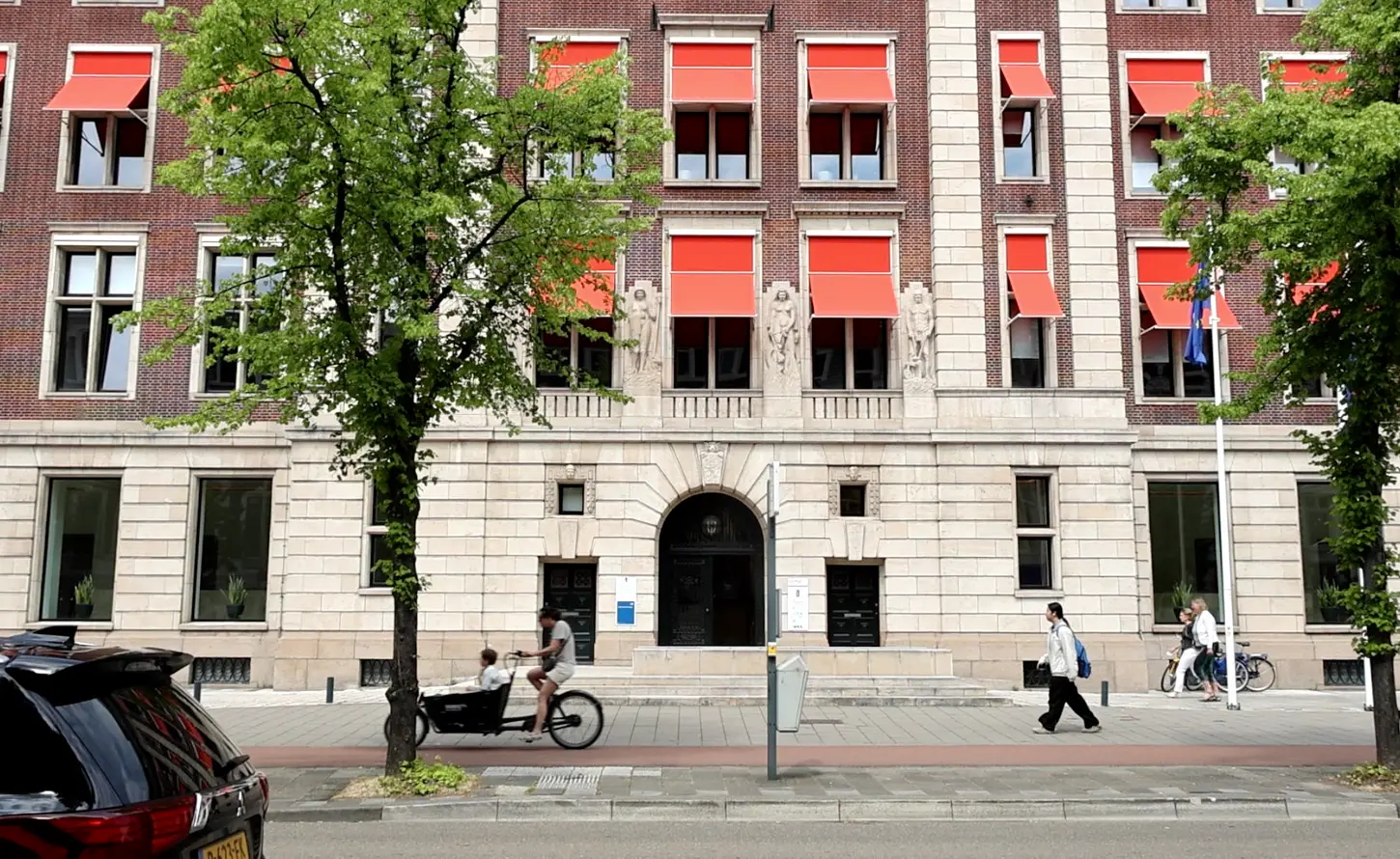
This interview was conducted by Leo Hickman at the PBL Netherlands Environmental Assessment Agency in the Hague, Netherlands, on 27 May 2026. Filming by Joe Goodman.