
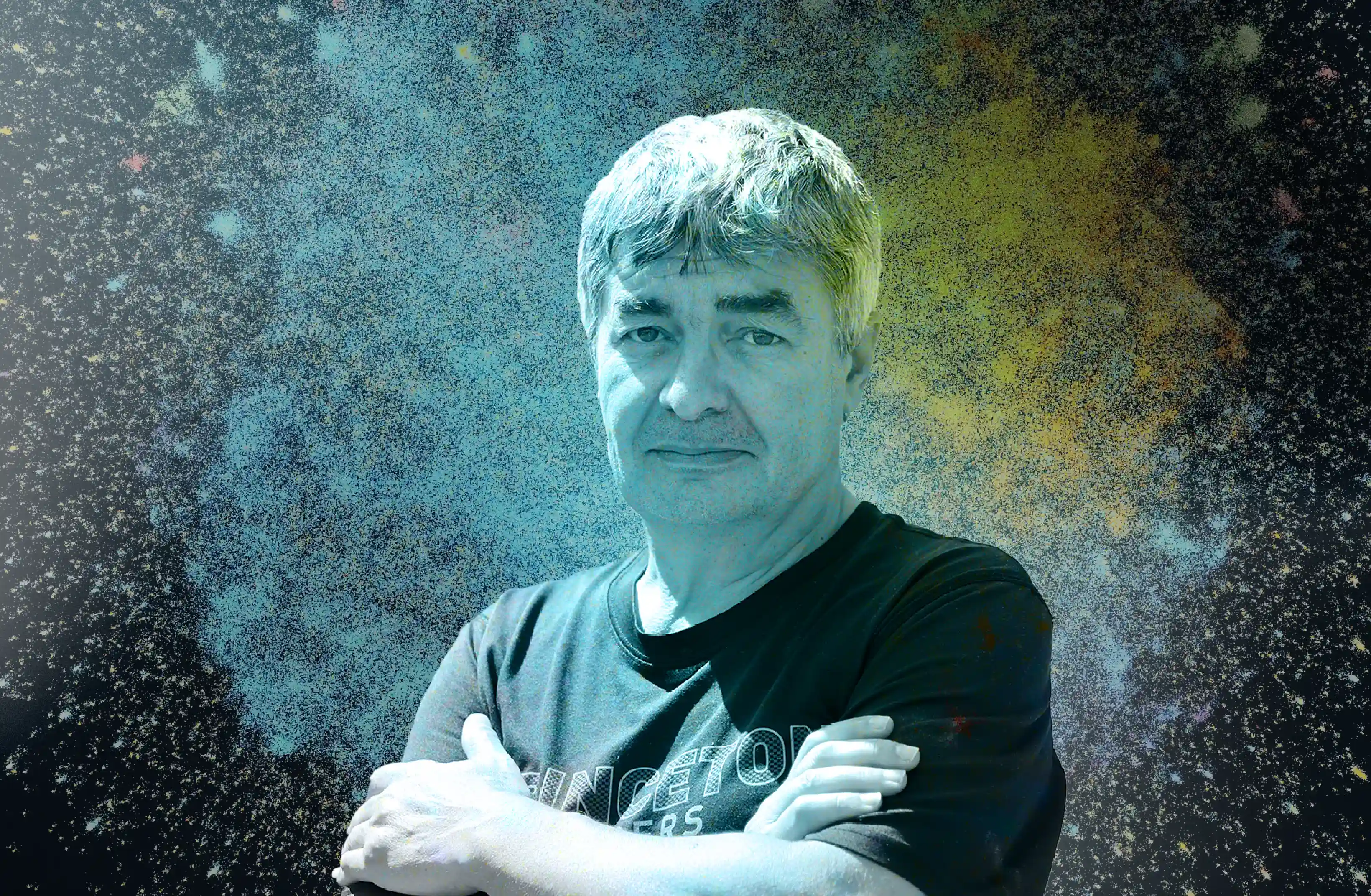
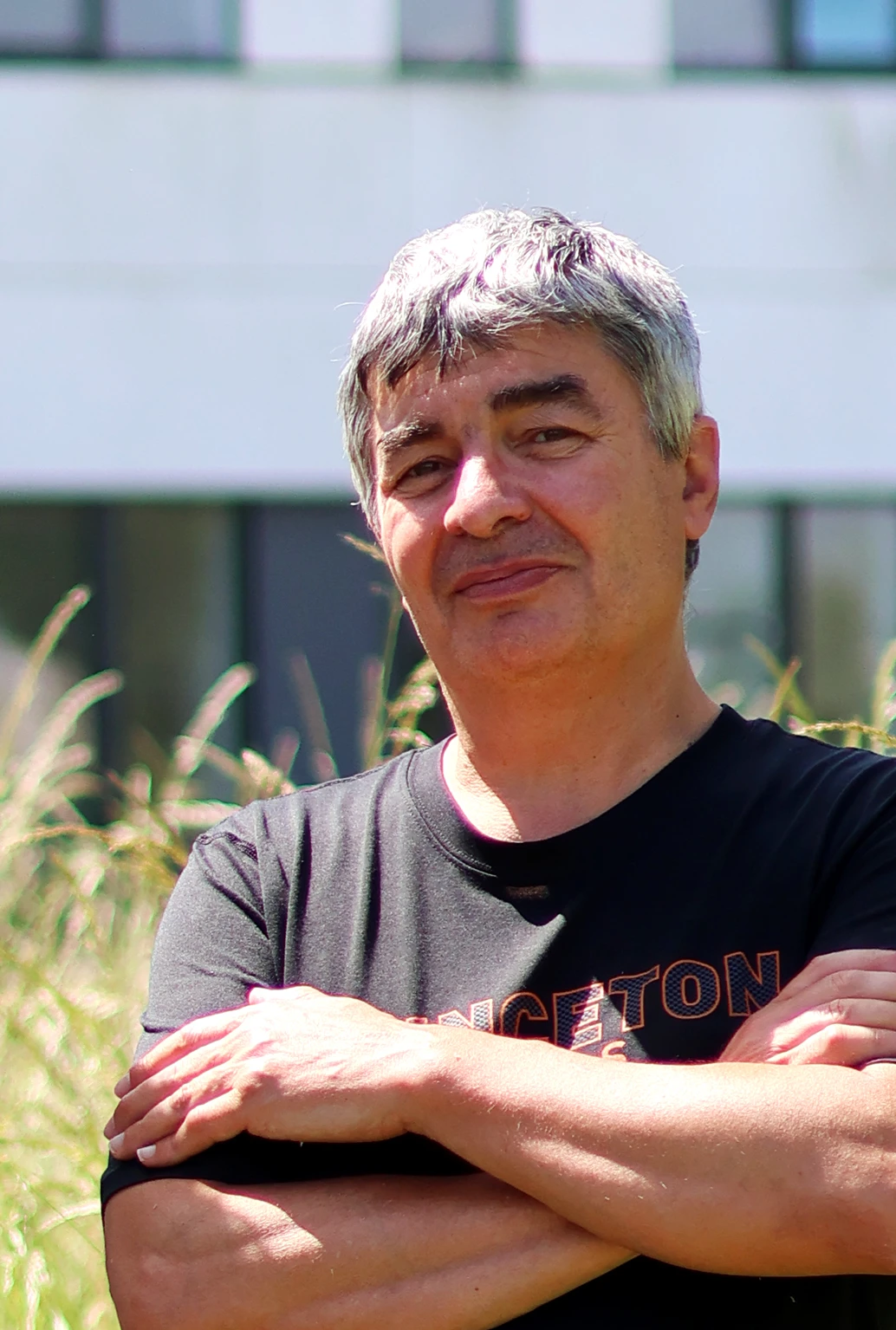
Phillipe Ciais has spent almost four decades researching the planet’s carbon cycle – and the ways in which humans have been impacting its balance.
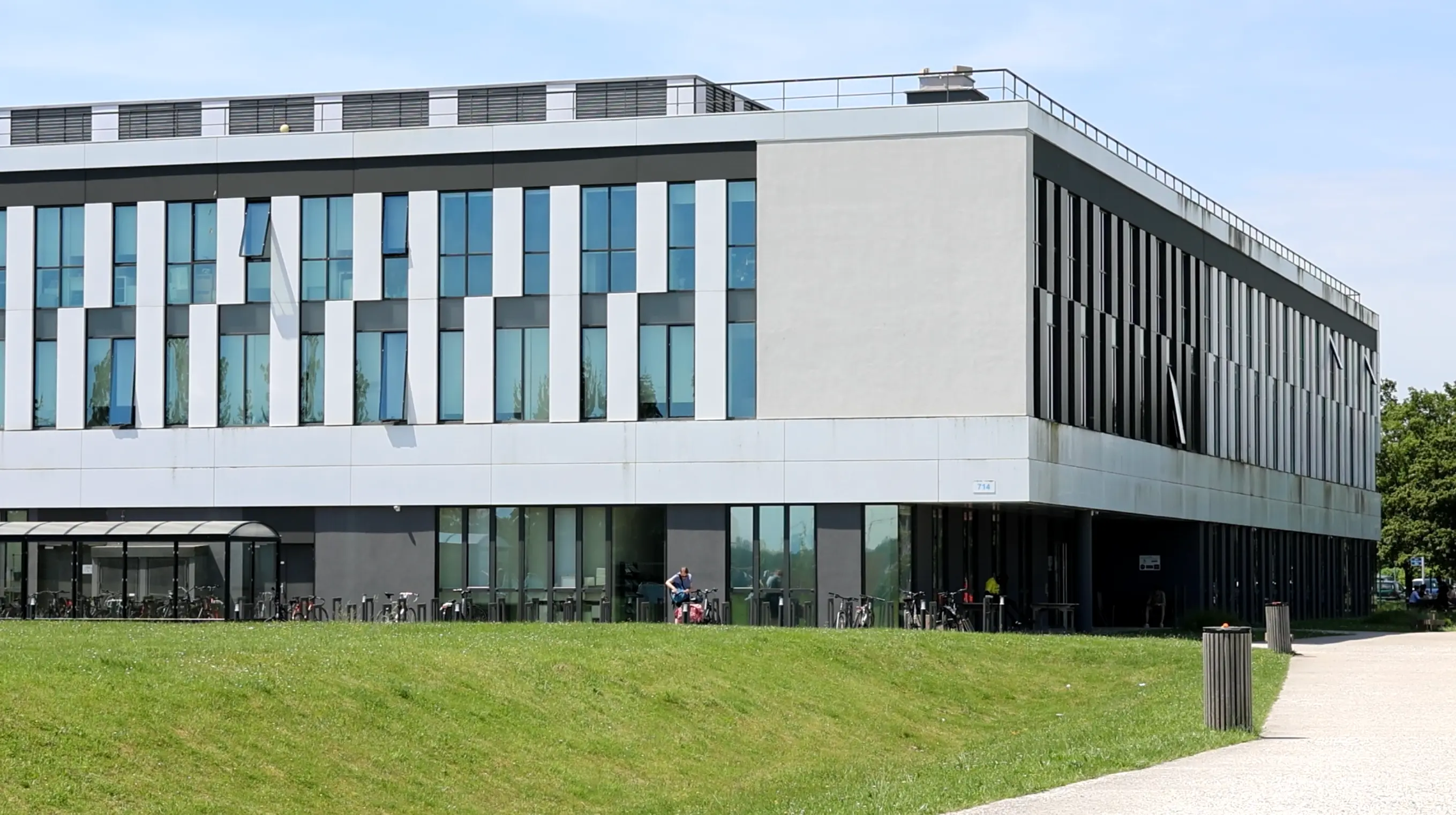
Based at the Laboratoire des Sciences du Climat et de l’Environnement (LSCE) on the outskirts of Paris, Ciais (pronounced “see-es”) has been listed as an author on almost 1,300 peer-reviewed studies.
In fact, analysis of Carbon Brief’s Cosmos database reveals that – by some distance – he is the most highly cited climate scientist in the world.
In a wide-ranging interview, he discusses:
- Why he is so concerned about the “imbalance” in the annual global carbon budget.
- The use of AI in peer-reviewed science.
- Why he is “not a big fan” of carbon dioxide removal.
- The difference between how China and the west view scientists.
- How he would choose to spend €100m on climate research.
1986-1989: Ecole Normale Supérieure, Paris, masters (solid state physics)
1988-1991: PhD, “Holocene climate record of Antarctic ice cores”, Laboratoire de Géochimie Isotopique, France
1992-1994: Postdoc in atmospheric sciences, NOAA-CMDL, Boulder, US
1994-2013: Scientist and deputy director, Laboratoire des Sciences du Climat et de l’Environnement (LSCE), France
2005-2013: European coordinator, Integrated Carbon Observation System (ICOS)
2009-2013: Co-chair, Global Carbon Project
2008-2013: IPCC AR5 Working Group I (WG1), coordinating lead author
2014-2017: Head of research, LSCE
2016-present: Yang-Tze visiting professor, Peking University
2016-present: Director, CLAND National Institute of Convergence, Université Paris-Saclay
Other highlights include:
On the impact of human emissions on the carbon cycle:
“We live on a very, very lucky planet, because half of these human emissions are absorbed by natural reservoirs, forests and oceans.”
On his concern about the changes to the carbon cycle:
“I'm very concerned…what we are seeing more and more is abrupt changes.”
On the threat to the carbon cycle:
“We live in a world where there is a fight between the good guys, CO2 fertilisation, and the bad guys, climate change impacting carbon sinks. So far, we still have carbon sinks, so the good guys have been beating the bad guys, but, in the future, maybe the bad guys will take over.”
On the challenge of analysing changes to the carbon cycle:
“We have very, very few stations or observations compared to the density of fluxes we would like to find…So, there are still, you know, a lot of assumptions.”
On the Trump administration’s attacks on climate science:
“It has been very appalling…Honestly, I would never have thought that it would come that hard, that quick…Right now [in France], it's OK, but maybe in five years we have, like, a French Trump and we will all be in the same situation.”
On the future of the IPCC:
“I'm a bit concerned that there is maybe a risk of bifurcation and fragmentation for IPCC.”
On the legacy of the Paris Agreement, a decade on:
What we see now is that there is a big gap between what countries promised…That's a big problem…[Some countries] have been over-reliant on land carbon sinks.”
On what keeps him up at night:
It worries me…that the complexity of the models has become so big that sometimes people don't even know what was in this part of the code.”
Interview transcript in full
Carbon Brief: Hello, Philippe, thank you for taking the time to speak to Carbon Brief today here in Paris at the Laboratory for Climate and Environmental Sciences. So, we are here today because our analysis of our new Cosmos database of climate studies shows that you are the most highly cited climate scientist in the world. Congratulations! Can we begin, please, with you explaining, in very simple terms, what your research focuses on, so we can all better understand why it’s had such a huge impact.
Philippe Ciais: Yes, thank you all for the visit. So, my research is about the carbon cycle and why we care about the carbon cycle because human activities emit a lot of carbon dioxide (CO2) in the atmosphere, the main driving force of climate warming. But we live on a very, very lucky planet, because half of these human emissions are absorbed by natural reservoirs, forests and oceans. All my work has been to try to understand which region is taking carbon or may sometimes release carbon, what are the processes. Is it because plants are growing better, or oceans are dissolving more carbon? And how can we anticipate what will happen for the future? And for that, of course, we make our models, so-called Earth-system models.
CB: There are some quite technical terms in your science. You’ve got terms like ”atmospheric inversion” and ”flux”, and they seem to be quite central to your research. What do these terms mean? And why is it so important for us to understand and monitor them?
PC: Yes, you have two ways to kind of elucidate. It’s a very difficult problem, because, on the planet, you have biology, you have physics, chemistry and they’re all intricate together. We know that ecosystems are terribly complex and they are very heterogeneous. Like one forest here can take carbon, you go one kilometre away, this other one can use carbon. So, how to get the carbon budget is a difficult problem, because you cannot measure every part of the world to get flux data.
So, [we have] two approaches. Either you try to get some local flux measurement, like agriculture, you get some points here and there, and then you try to fill the gap to produce a nice map, and this is called the bottom-up approach. It’s powerful, but, of course, in entire regions where there is no data like in Africa or the Southern Ocean, you make big extrapolation errors.
I’ve been working on another approach called the atmospheric-inversion approach. The idea that the atmosphere is like a huge flux transfer. It receives everything. And, in fact, at the end of the year, if you look at the growth of atmospheric CO2 at Mauna Loa, a single station, you know how much carbon has stayed in the atmosphere, everything, including emissions and removals. If you have a bit more station than Mauna Loa, let’s say [a] station in the north or station in the south, etc, etc, you see that they are not all the same. You have [inaudible] atmospheric concentration gradients which reflect two things; the atmospheric mixing and the fact that you have different regional fluxes.
So, the art of atmospheric conversion – that’s why it’s called an inversion problem – is to take the concentration gradients in the atmosphere to simulate the effect of atmospheric mixing and to reveal the effect of fluxes. So, it provides a map of fluxes which is fully consistent with a nice, small observed atmospheric gradients between sites.
It has some advantage in the sense that it is complete. It’s a mass balance approach. There is no risk of missing any flux in the big regions, but the problem is that it’s mathematically a new atmospheric problem. We have very, very few stations or observations compared to the density of fluxes we would like to find, so we still need to calculate the mathematical system by giving it some constraint so that the solution doesn’t look crazy. So, there are still, you know, a lot of assumptions, but the beauty of this approach is that it’s based on physical mass balance. And, if it is complete, you don’t omit some fluxes, and that’s a very important point.
CB: So, you talked about these fluxes and the way that the planet’s atmosphere mixes and things. So, you’ve got the natural processes, but, obviously, there’s a human process now. Can you just explain what the negative impacts are on that balance, that cycle, that humans are causing?
PC: Yes. So, humans release CO2. And, once CO2 is in the air, it’s not going to get out soon. It takes centuries, millennia before it’s cleaned up. And this extra CO2, which is loaded in the atmosphere, it has two effects. One is a good one, the other is a bad one. The good one is called the CO2 fertilisation. The fact is that, when you emit CO2, you create an imbalance between the atmosphere and the ocean, and the ocean wants to take more. A little bit similar for the plants. Plants take more photosynthesis, they are more active when there is more CO2 in the air. Everything there is OK like water, nutrients, a good temperature.
So, if there was only a CO2 fertilisation effect, we would be happy, because, basically, emissions could be removed. The problem is that there is a kind of malefic [harmful] effect of CO2 in that it also warms the climate and this climate warming has very bad consequences, negatively affecting carbon intake.
So, we live in a world where there is a fight between the good guys, CO2 fertilisation, and the bad guys, climate change impacting carbon sinks. So far, we still have carbon sinks, so the good guys have been beating the bad guys, but, in the future, maybe the bad guys will take over, like permafrost, the carbon release, and they will turn our planet into like [inaudible] CO2. That’s a bigger [inaudible].
CB: I wanted to ask you about that. What concerns do you have kind of into the future, or now even, about the ongoing ability of the land and the oceans to take up carbon? And balance up. Are there concerns there about whether – you talked about fertilisation and the oceans absorbing [carbon] – taking some of that CO2, but does that balance go on forever, or do you have concerns about that?
PC: I’m very concerned, because we have been trying to simulate for, like with the IPCC Earth-system models, gradual changes. So, there is slowly higher CO2, the trees take more carbon. There is a rise of temperature, little bit more extremes, and sometimes the plants and the oceans are affected.
But what we are seeing more and more is abrupt changes. Like you have a hot summer in 2023 in Canada and 11% of the boreal forest is burnt and releasing CO2. We have a massive drought in the Amazon and trees can die in these laps of one or two years. We have heatwaves in Siberia and we see that all these permafrost frozen ground is collapsing in one year.
So, all those abrupt change processes, when you measure them locally, you see very big carbon losses. And the big problem is that, in the field, we see that they are very dangerous, but, in the IPCC models, they don’t exist. Most of the IPCC models which have been used to predict the future of carbon sinks, they don’t simulate tree mortality from drought. So, when there is a drought, there is a little bit less carbon taken by photosynthesis. The year after, everyone is doing well. In reality, when you have drought, you kill all the trees and you can, perhaps, replace your forest by another system.
So, models have been kind of adjusted to look for carbon gains, but they have not been developed enough to look for carbon-loss processes. And the fact that we have this asymmetry of knowledge is a big problem, because you could argue that we are, perhaps, over-optimistic by underestimating, or not looking at the carbon loss processes.
CB: So, in terms of the asymmetry and problems in terms of understanding this, what, in your view, is causing the roughly [up to] one gigatonne imbalance in the annual global carbon budget, which, as I understand it, I think you’ve tried to investigate? Do you want to explain that a little bit?
PC: Yes, we have an imbalance. So, basically, the balance reflects the state of the knowledge [inaudible] and the way we do the budget is that we know from [top-down] atmospheric data what should be the magnitude of the planetary things – in the ocean and on the land – just by mass balance, and you observe that atmospheric loss rate. And then we use ocean simulators and land-carbon simulators, and we try to produce a bottom-up estimation. We check your bank account and there is an imbalance [between the top-down and bottom-up methods].
So, it’s a problem, because the large imbalance means that we aren’t capturing something.
CB: Do you know what’s causing that imbalance?
PC: [Laughs] So, that’s, I think, it’s a very important scientific question. I think the question should be more: what are the regions that are contributing a lot to the imbalance. It’s not like the culprit is the ocean, or the culprit is the land, but is it because we don’t have the right processes for the tropics? Or because we are missing high-latitude permafrost feedbacks?
What we tend to see is that the imbalance becomes larger when you have extreme climate events. Like, when you have a big El Niño, like the last one in 2015 and the recent one in 2023-24, you see that all the models that are, on average, have an imbalance suddenly, during that year, they don’t understand something because they don’t get the right balance, which tells us that there is something missing in these models about the response of land, maybe oceans, to climate extremes.
That’s something to worry about, because we have a lot of climate extremes. We know that the models have missing processes. Like, currently, none of the budget models is simulating the boreal fires. You ask them, make a prediction for the Canadian fires in ‘23 – we’re talking about a big anomaly of a gigatonne – and the models will say there is nothing. So, we know that there are pathological problems. They combine, because some errors can be positive or negative, but we have hints that the imbalance is not zero, because models don’t simulate the response to extremes. And it rings a bell for the future because, if we don’t capture extremes, extremes are, basically, a natural experiment that can inform you about what could happen in the future. If you don’t get this right, it means that your future predictions could also have problems.
CB: So, just to put this in context for our Carbon Brief audience, so a one gigatonne [of carbon] imbalance, that compares to human emissions of, what, 40 gigatonnes [of CO2] a year, roughly?
PC: That’s about half of China, or the entire EU emissions.
CB: So, it is significant…
PC: It’s significant. It’s quite significant. Of course, the models have some tunings. They don’t want to produce a stupid result, like five times more carbon sink in the land than what is conventionally accepted. So, generally speaking, modellers, to participate, to do the budget, they can adjust a few parameters to match the average carbon sink. So, their average imbalance is never very big. It’s not one [gigatonne], it’s 0.1. But one particular year, like last year with a big El Niño, and you have an imbalance of one [gigatonne], which is revealed, because the models do not simulate well the impact of extremes on the carbon cycle.
CB: What is your view on CDR, carbon dioxide removal? Are you concerned that negative emissions technologies are too baked into emissions scenarios being used to inform policymakers? Is there too much focus and hope placed on things like nature-based solutions and BECCS, bioenergy and carbon capture and storage?
PC: Well, of course, I’m not a very big fan of, let’s say, CDR because there is clearly this moral hazard. If you just say, “Oh, this is the economic calculation of the IPCC and, uh, we can make 1.5C, provided that we get enough CDR”, people will understand that we can [limit global warming to] 1.5C. And they will not necessarily understand that CDR is something which does not exist at scale today. It costs a lot and we have a lot of scientific uncertainties about the permanence of CDR. It’s well known that, if you plant a forest, sooner or later the carbon may disappear.
So, on the one hand, we are getting desperate because we passed 1.5C [in an individual year], we are heading to maybe surpass 2C of warming, so everything that could reduce carbon dioxide looks like something that has to be studied. But, today, it doesn’t exist at scale. It causes, let’s say, hazards in terms of generations because you are going to ask your sons and grandson to clean the problem, which is not obvious. It has some technological barriers, which are very strong, and also something, which is maybe sometimes not seen with CDR, it also has some equity between the [global] north and the south, because the big options for CDR are in the tropical countries. They can still plant a lot of forest, but they are not contributing too much to the current historical CO2 emissions. So, basically, rich countries, or big emitters, are going to ask countries from the south, “Can you do CDR for us?” And that’s a typical problem of climate justice that will have to be sorted out if we really want to move to the yard scale.
CB: So, you mentioned that we’re kind of past 1.5C which, I guess, if you’re assuming overshoot scenarios which have huge assumptions around carbon dioxide removal…
PC: Yeah.
CB: So, your concern is that we’re already basically breaching 1.5C, the Paris Agreement, we’re heading towards 2C pretty fast…
PC: Yeah.
CB: …and if we go beyond those and, at the end of the century, we want to come back down to those temperatures, as some of the modelling is trying to assume and investigate, the carbon dioxide removal is obviously essential to bring it back down and, as you say, there’s a lot of, not just assumptions, but problems that quickly come out of that…
PC: Yes, there are two problems with CDR. The problem is that the more you let things go and emit, the more you have to clean. And, since it’s not easy to clean up carbon, otherwise we would have done it already, the economic, technical feasibility becomes smaller and smaller. Basically, maybe we could restore, let’s say, terrestrial carbon stocks by, let’s say, one times the Amazon. Suppose we plant all the forest in the good areas. But, if we have to pack away on land 10 times the Amazon’s carbon, where is the land? We cannot do that. So the more we continue unattended, the more the CDR becomes something that may help to fix things, but it won’t bring us back to 2C.
CB: So, you are concerned that today’s policymakers maybe have a signal that this is tomorrow’s problem, the next generation can deal with the implications of CDR…
PC: Right.
CB: …but it allows today’s policymakers to maybe feel a bit better about some of the choices.
PC: Right, because, for me, if you start to produce scenarios with CDR options, the first part of the message is that we could do 2C with CDR and will be very well understood by politicians and the government. But the second big question is: can we do the CDR and can we do the investment? And this is not done. So, that’s a big problem, of course, for this.
CB: In recent years, there seems to have been an increasing policy focus on the short-term impact of methane emissions. Is this sensible? Or are there risks to this approach where policymakers begin to focus on methane maybe more than carbon [dioxide]?
PC: Yeah, let’s say, you can see that as a good thing or a bad thing. The good thing about methane is that it’s a very strong warmer. It warms the climate more strongly than CO2. And it has a very short lifetime. So, if you press on the button to reduce methane emissions, in principle, you could cool the climate. So, this is fantastic. However, it has not happened yet.
The Glasgow pledge was supposed to bring down methane emissions by many countries by -30% in 2030. All the atmosphere data we have show that fossil and agricultural emissions have stayed constant, or been going up.
Then there is a risk of – it’s a bit like CDR – governments will say, “OK, CO2 is too costly, we won’t manage.” So, like CDR, let’s try to promise very big methane emissions reductions. So, there is a reason there is a shift in the priorities and in the discourse that everybody can agree to reduce methane emissions, but, of course, CO2 stays in the atmosphere. So, even if we manage to do something for methane emissions, we still have to address the problem of CO2. So, it’s the same kind of hazard about delayed action that we have for CDR. We jump on methane, it’s low-hanging fruit. We make big declarations and we delay the necessary action in CO2 emissions.
CB: You’ve studied proxy data a lot. So, looking at ways to analyse former past climates on the planet to help inform our understanding of today’s and future climates. What, in your view, are the remaining knowledge gaps that remain about the planet’s past climates? And do you think we’ll discover new ways to fill in those kinds of data gaps around this?
PC: Yeah, well, I’ve not been doing palaeoscience for a long time. I did that for my PhD. Of course, at the time this ice core data were incredible because they gave us lower temperature and lower CO2. We found that they were, of course, very tightly associated with each other. One very interesting way to look at this palaeo record over, like, the last million years or even more is to understand what is the long story between CO2 and climate. In other words, what is the climate sensitivity? So, if you increase CO2 by 100ppm [parts per million] from the observations – so everything including ice heat changes, vegetation, migrations, erosion – how much is the climate warming? And that’s a very good benchmark.
And, of course, James Hansen has been using this brilliant idea to compare this kind of empirical estimation of very long-term scale climate sensitivity with what is projected for the future by climate models.
CB: What is your view on climate sensitivity? What is the range that you think [is right]? And has that view changed over time? And, if so, in which direction?
PC: Well, being a carbon-cycle person, I prefer to speak about the so-called TCR [transient climate response], you know, the kind of response of climate to emissions. I’m reading and probing, as an outsider, the future on climate sensitivity. I’ve seen that in the last IPCC [WG1 report] two modes in the distribution, some very high sensitive models and some very low ones. So, I wouldn’t say which one is better or worse, but it’s interesting that now, when the model gets more complex, in a probabilistic sense, they give you worlds where the climate sensitivity could be much higher than any previous model generation.
I think it also tells something that, in adding – in principle – new and more realistic processes in the models, more validation and so on, we don’t shift the distribution towards lower climate sensitivity, but we shift the probability of higher current sensitivities to increase.
CB: You did your postdoc in the early 1990s at NOAA in Boulder, Colorado. What has been your reaction to the Trump administration’s recent attacks on climate science, namely, its desire to basically defund and destroy research institutions in the US focused on climate change?
PC: Yeah, it has been very appalling because, somehow, the US community was leading a lot of this climate science, including incredible observations, like long-term carbon dioxide observations. Honestly, I would never have thought that it would come that hard, that quick.
When I was discussing with climate colleagues after Trump was elected, before he went to the White House, they said, “Well, we have plus 10%, 15% budget increase with the previous administration. With Trump, we’ll get minus 15% and we’ll remain stable.” But, in fact, the change is happening at the rates that nobody had anticipated.
The communication battle was lost, clearly, because we thought, after the success of the communication for the last IPCC report, that the entire society would be completely convinced of the importance and the urgency of climate change. But the discourse has changed. You know, all these people that say it’s hoax and, because it’s hoax, I’m going to defund it.
So, I’m very appalled by the rate of change of events. And, of course, when you look at this, you say, “Well, what will happen next in my little country?” You know? Right now, it’s OK, but maybe in five years we have, like, a French Trump and we will all be in the same situation. And that’s really like in the movie Don’t Look Up. It’s exactly what they have in the movie [that] is happening. So, it’s a very serious problem.
CB: You’ve spent time in China working as a scientist. How do you compare your experiences of working here in France, in the US, in China? Obviously, three quite different situations in which to operate as a climate researcher and scientist. How do you compare those three?
PC: Well, it was not at the same time. When I was in the US during my postdoc it was an incredible place to work, because the environment was very open. You could discuss with a lot of very experienced colleagues and they would share their ideas and listen to you as a young scientist, which, at the time, did not quite exist in France. So, this future of openness and discussion, I think I learned a lot from it in the US. Of course, we took a lot of it into France and Europe and we went from, like, pyramidal systems to more of a network of scientists.
And, having worked in China, I have been completely impressed by the ability of Chinese scientists to learn about things. When I started to work with them I had the impression that I had a big amount of knowledge and that I was explaining to them how to do things. They were, of course, working very, very hard, but it would take 20 years. It didn’t take 20 years. It took five years to, let’s say, reach exactly the same level.
And now, of course, they are ahead of things because of two things. In general, people work very hard. They have a very strong work ethic and, of course, in the end, it’s also the amount of effort you put into research that delivers.
The [science] community [in China] has also learned how to communicate. Before, for instance, they were, in China, less able to write high-profile papers, because it doesn’t require just scientific technical skills, but narrative and communication skills. Because the way you turn a result to a Nature paper is, basically, it’s like a journalist. You have to be a good storyteller. And, the Chinese community, they were confronting this barrier to [getting a paper into] Nature, but they have passed it. Now, they are extremely good at having a high-impact paper because of the storytelling, which is, of course, a very big component of this paper.
And also I have the impression that, in China, being a scientist in society is something that is good, you have a good salary, a good social status, good respect and a good career prospect. In Europe, [laughs] it’s a bit more like you’re marginal, you accept to have lower salaries against more freedom. And the consideration for what you do in society is not that high. So, the shift in [this] value has also shifted very strongly in China.
CB: Because of that, do you anticipate, in the next 5-10 years, Chinese climate research to just be only ascendant? And do you think it [China] could come to almost dominate climate research in the next decade or so, if you see some of the trends happening in the US and maybe even in Europe around the funding and focus on climate research?
PC: Yeah, I think if you make a best scenario, this will happen even sooner. Maybe even now it’s already the case. Of course, you have some geopolitical situations and maybe, you know, there will be a downplay of climate in China. But, right now, even for very fundamental aspects, the Chinese and Chinese community will, of course, dominate everything we do, because they have invested a lot in big experimental facilities and experiments are extremely important in advanced models, theoretical models.
Now, AI is helping our field a lot. And it [China] also captured how AI could be harnessed to improve climate models to assess carbon sinks. Maybe the only weakness of the huge and diverse community [of scientists] in China is that there is not yet a culture of open data sharing, in particular for satellite data. NASA has been putting all the NASA satellite data open. And it’s millions of papers. Either in Europe was lagging behind, the land satellite, but you couldn’t find either data. And now, with a programme called the [ESA] Climate Change Initiative, in fact, the best data centre for permafrost or sea surface temperature is there in Europe [with] Copernicus.
China has an incredible satellite programme like Gaofen, an incredible set of satellites, but, still, you don’t have a data portal where you can find all this data for the science community. And this is still the next step [for China] is to understand that, let’s say, being a dominant player in the world in science, you have more to gain if you share data and information rather than if you keep it and think that you are more competitive because you have, let’s say, private information. So, that will be the challenge.
CB: Which leads me onto my next question, which is a hypothetical question, which is: say, today, I have a cheque, or I have in cash €100m and – I don’t [laughs] – but I give it to you. What research priorities would you spend that €100m on? Would you expand the network of land-based monitors that you’ve been involved in? Or would you rather spend it on a brand new satellite, for example, to capture new data? Or maybe something else altogether?
PC: Well, you have to put your money in the right place because, let’s say, for €10m you can do major progress in improving climate models. For €100m, you can launch half of a satellite. [Laughs] So, if you have to consider your assets, there are different possibilities. I would put maybe one-third or half of it to produce an extremely accurate digital Earth for the current carbon cycle, like tree level or, you know, ocean current level, maps, empirical maps…
CB: So, what kind of resolution do you think you’d need?
PC: Well, typically for land, you can go to five-metre resolution. For [the] ocean, maybe, one kilometre by combining AI, Earth observation and physical process models to have, basically, a reference digital twin of the current carbon cycle. That would be, of course, a priority.
I would spend 25% with a very good postdoc to try to add the missing carbon processes that we were talking about in the carbon models to reduce the imbalance precisely, in a coordinated way. And we know that we need more observations, so we need both more bottom-up flux towers and atmospheric observations.
But we know now that the atmosphere is a very important reservoir. Its atmospheric inversions are complete. And we have found a way to measure atmospheric CO2 at a cheap cost with upward-looking remote sensing instruments. Before, our station was costing, like, €1-2m. And now, for €200,000, you can buy almost an autonomous greenhouse gas sensing station. And, in Africa, there is no station. In South America, there are two. In south-east Asia, there is one.
So, having 20 stations in Africa, a similar number in the tropics, I think would be a terrific fast progress in five years to reduce the uncertainty on the budget from atmospheric observations.
CB: Do you think someone is going to fund that? Is that actively being argued [for] right now, or is that just remaining a big data gap now in those key regions?
PC: Well, everybody agrees that there’s a gap. You have two ways to fill the gap. Either you go through the UN and the WMO, and you have a strategic plan and a lot of committees. But, in the end, there are not too many stations added, but still engagement of countries to host observation remains important.
Or you can try to convince donors. In particular, a lot of philanthropies who can change the game. And, for instance, we’re installing a new site in Africa. We got a donation with me and our US colleagues, a philanthropic gift that will allow us to get five instruments. And that’s very important, because if one donor gives five instruments, it’s €1m, it’s not too much. Another is giving five instruments for the Amazon and so on and so forth. You can build a network with transparent data processing. So, I think philanthropies, in particular, in the US have been a very powerful leverage to fund this kind of project.
There are some risk, because, in the US, philanthropies are rich, more rich people. And because they think it’s associated with tax exemption, they have the duty to spend money in the year, which means that they must give cash. In France, we have foundations where they can keep the money for 10 years, so they’ll say, “Write a proposal, we’ll see next year.” If they have a budget cut, they will postpone the budget. So, having both powerful philanthropies and a good regulation that is there to spend a significant fraction of their funds every year, I think it’s a very important thing.
And buying the instrument is good for this kind of donor because pouring money into better climate models, you have to like this. Adopting instruments – “I have five instruments in the Congo rainforest” – that is something, you can appropriate this slightly better. And, of course, a digital Earth and AI is also very popular for all the donors. So, if you have some kind of AI in your [project] keywords, like for startups, the possibility to leverage funds is probably higher.
CB: You’ve played an important role as a convening lead author with the IPCC, the Intergovernmental Panel on Climate Change. Looking forward into the next assessment cycle, is the IPCC, with its 6-7 year wait between reports, still fit for purpose? Can it still inform today’s policymaking with such a slow pace?
PC: Yeah, I’m a bit concerned that there is maybe a risk of bifurcation and fragmentation for IPCC because, if you have a slow process, people will do nothing, or the assessment will not be completely comprehensive, because science is still progressing quickly.
The other risk, but I’m not following changes in IPCC very closely, is that governments say, “OK, the knowledge basis, we know it, nobody will see it. We only read the summary for policymakers, we trust you for the chapters. So we don’t need a carbon chapter.”
It’s a way to say it’s not important. “We need something about adaptation, what we have to do [on that], and we need specialised reports, like a report from cities, a report on the tropics.”
And this has a fragmentation effect because there is only one climate problem with multiple impacts. And, if you start to have a report only on cities, only on chemistry of permafrost, it will be very useful, but we lose the big picture, which is that CO2 increases the global problem. And global emissions are changing the climate for everybody. So, you need to understand the global carbon cycle and not think that it’s a known engine. And now we have to look at the consequences.
CB: Are you a bit concerned because, right at this moment, there’s a bit of a battle going on amongst countries about the timeline of the next IPCC reports, whether they should be before or after the next global stocktake. And it seems there’s a tension which, at the moment, is not resolved, right?
PC: Yeah, I’m not following this, but you understand that, some countries, they want to delay or to weaken the IPCC. That’s very clear. And, some countries, they want to have more frequent assessment.
And what I’m feeling now is that if it gets too slow, the impact will be much less. Typically, people want information about last year. And one of the reasons for the very highly cited global budget paper is that it’s a yearly project. So, every year, at least you have the microphone for one day, you can explain the current budget. And it has a very big impact in the media everywhere, because it’s a yearly project.
For other budgets that will produce every five years, the impact is 10 times less. And you can see that the IPCC is the same for climate. People want to know if 2025 was a bit cooler than ‘24 or not and they go to the Copernicus website to understand the global temperature. They don’t have to wait six years for the IPCC to tell them that ‘23, ‘24, ‘25, have been the warmest years of the century. People want something fast.
Typically, there is a big monster or possibly very large [El Niño] coming in ‘26. We want to have the answer [about] how it’s going to affect the carbon cycle in early ‘27, not later in 2030-something.
CB: So, a decade ago, the world’s leaders gathered here in this city for COP21. The outcome was, obviously, the Paris Agreement. Looking back, knowing what we now know and living with the current geopolitical tensions, what impact do you think that agreement has had? And what comes next for climate action globally?
PC: So, the agreement has a meaning to exist, because we had several failures before, like, Copenhagen [COP15 in 2009] failed, because, I think, countries tried to have a normative approach where everyone would have put out emission reductions, and this failed. So, Paris, in a sense, was weaker, because it’s just everyone is pledging something, putting cards on the table and then we take some of the cards and we see if the pledges are good or not. So, in the beginning, of course, the momentum and the fact that almost all the countries agreed to sign the treaty, it’s [a] very important event.
But there are some loopholes. The fact that, I would have thought, pledges would be very hard-carved in stone and they would be followed by implementation policy and that governments could even be sued, if they don’t implement their pledges. What we see now is that there is a big gap between what countries promised. If you believe all the promises, we should be [heading] at a little bit more than 2C, or not too much. But, if you look at the real emissions trajectory, we are going to be much warmer than 2C. So, there is a difference between the promise and the action – and the difference is increasing over time. We’re not [inaudible] effect, nothing. That’s a big problem.
And, unfortunately, because Paris [does not] have like, you know, a mechanism of regulations for countries that don’t keep their promise, the gap is widening and, when the countries rendezvous in 2030, I’m wondering what will happen. They will say, “Oh, we have a bigger gap.” And they will say it’s because there was a war in Iran, you know, it’s because there was Covid, it’s because there was some drought and we had to emit more to cool our population, or we wanted economic growth and we couldn’t start decreasing carbon emissions.
So, what I’m afraid of is that we’ll be in front of a big emission gap in 2030 and countries will have good reasons because of economic downturn – for sure, political reasons – for explaining that it’s not their fault.
And also countries have been – maybe some of them – have been over-reliant on land carbon sinks. Like, typically, in Europe, we have forests and they were taking as much carbon as the emissions of the entire Netherlands and Belgium. So, I think even France and Belgium. It’s a significant absorption and the European commission opened the Pandora’s box. They said, “Well, because reducing the emissions, it’s very hard to get to neutrality, you could get a little bit of help by putting the forest on board.” So, of course, they put the forest on board, industrial effort becomes less, and now we have seen that the European carbon sink has really [declined] because of climate change and [inaudible] by 30%.
So, this is a fact, but what are the countries doing? Well, they do nothing. They say, “Oh, too bad, our forest are not taking enough carbon.” But the consequence is that they want to be the target. They should say, “We should do more effort in other sectors, or we should manage the forest in a completely different way.” But they witness the problem arising with collapsing forest carbon sinks without any clear action to either readjust the target or take stronger actions. So, that’s a typical example where there is a gap between what you see happening and what you would need to have for 2C.
CB: Thinking about the Paris mechanism and the kind of framework of it, do you agree that nations should still self-report their emissions when scientists could now do it with far greater accuracy and in real-time using satellites and other measurements?
PC: Well, I think self-reporting means it’s a mechanism countries can accept. And we have to be a bit modest on the scientific side because, let’s say, satellite promoters have conveyed the idea that satellites can measure emissions. Honestly, it’s not possible, because satellites are very sensitive to clouds. Imagery is very poor. Satellites are good to get a good map of the natural carbon sinks, that’s fine. But satellites cannot give you accurate emissions for London, or Paris, or France because they don’t observe accurately enough the column of CO2 over big cities. We have a lot of small villages, small towns which are basically invisible from satellites.
So, we still, everybody, has to rely on national reports. The global carbon budget we use, we produce emissions, but they are based on national data. The International Energy Agency is producing their emissions [analysis], it’s based on national data. National reports are, obviously, based on national data.
The only thing which differs is the amount of salt and pepper that everybody is putting in the calculation of the gap-filling. But, right now for fossil carbon, we still need national energy data. However, for other gases like methane, or for natural carbon or forces, yes, scientific data observations are quite powerful.
So, I still think we need national reports. Maybe the mechanism has to be more transparent, but, its commitment, the Paris Agreement has a transparency framework. It’s good that the scientific community is comparing their own estimations with the national data, but I think it’s an error to think that the scientists for fossil CO2 have their own independent observed estimates that they can match against country data. So far, it has not yet happened.
CB: With the rise in the use of artificial intelligence and ever smaller research budgets, how do you see the future of the peer-review system within academia that underpins all climate science, really?
PC: Yes, it’s like Trump, it’s an ongoing experiment that we are all [laughs], you know, trying to grasp with improper data. So, I feel, like your big bibliometric study [Project Cosmos], we need statistical data and analysis of the impact of AI on the peer-reviewed system.
There was a survey published by Nature last year and they found that everybody who responded is already heavily using AI for reviewing other papers or writing their own papers and, maybe they don’t say it [laughs), they understate their use of AI.
And there was another very nice paper in Science where they looked at paper-writing and publication acceptance rates before and after [Chat]GPT, kind of counterfactual models. It’s actually what we do for climate science. And they found that, after [Chat]GPT, there was an increase, very sharp increase, of the number of publications, but the acceptance rate per publication decreased a lot. So, the effect of AI from this single study seems to be that it will facilitate, of course, a proliferation of studies, but because journals have a limited capacity and also because reviewers are starting to use AI to do their review, the rejection rate will increase a lot. So, more studies [laughs], but less high-impact studies, because journals will be flooded by studies of uneven quality.
And, also, if you delegate to AI the care to review papers…I think I have submitted papers and, the reviewers, you can see that it has been reviewed by an AI. And the AI is very what? Basically, the reviewer is prompting, “I want to reject this paper, or give me some good reason for reject.” And you can see what the AI is doing and it’s very difficult to fight against that.
CB: So, you suggest there’s, at the moment, a bit of a self-correcting mechanism, because, even though there might be an increase in the number of papers submitted and reviewed, the ones that actually pass is decreasing so, maybe, it balances out. But it sounds like, in the future, that balance, currently, might not maintain itself and we may just see an ever-increasing rise in papers. But, presumably, is your concern that they just might be lower quality, or they might be very bland and non-unique?
PC: Yes, the concern is about non-unicity because it accelerates things. You know, a proliferation of studies. AI accelerates also the doing of research, like, you can analyse data with statistics. Before it took months of coding and, now, you just ask generative AI…
CB: Are you fine with that?
PC: I’m fine with that.
CB: Certain uses of AI are OK? But, for some, there’s a red line and you don’t want to see it?
PC: Well, we don’t have experience and it’s progressing so fast that, right now, you could say that papers written by AI you see that they don’t have a good quality, but maybe, tomorrow, generative AI will write perfect Nature papers because they are learning so fast. So, maybe there will be a decrease.
CB: Presumably, the key to science, right, is you can replicate, you can reproduce the findings?
PC: Yeah.
CB: So, if the AI, the code or the way the paper was written is, effectively, a black box – you don’t know how the AI did it – is that key pillar of science that you can reproduce a finding, is that increasingly eroded?
PC: You’re right. I think there is a risk of erosion of reproducibility. On the other hand, it’s a double-edged sword, because AI could also make code more transparent. For me, of course, we need some kind of guidelines to declare if AI was used to write papers, for which reason and in which place in the papers. And if AI was used for reviewing.
For me, the big problem is for the review. Because if all the review is delegated to AI, it can become very subjective. And, then, the other problem is that a journal like Nature, every year in a big Nature journal, I think there is room for, I don’t know, 10-15 climate papers. And they won’t increase. It will still be 10. So, if AI makes it double or triple the number of input papers, the filter will still be there for very high-profile papers, because people can only distillate and read Nature for 10 papers per year. Which means that there will be a lot of junk and people disappointed by high-profile journals. And maybe some other journals that will take the opportunity, including Nature and Wiley, they will say, “Let’s open new journals to be able to accept all these papers and the revenue that comes with the papers.”
So, I think we will see a proliferation of papers. High profile will still stay high profile and we will see a lot of opening of new papers to accept the flood, the wave of AI-based papers.
We are also going to see that the future will come also from China because, right now, it has been very important for the Chinese community to publish in so-called western journals like Science, PNAS, Nature, but they also will invest to have their own Chinese Nature or Chinese Science. And maybe, in 10 years, we will see this because [laughs] the production is so high in China that the most highly cited journals will not be Nature Climate Change, but will be a Chinese equivalent.
CB: So, you can imagine, in 5-10 years, Western climate scientists trying to get their new papers published in Chinese-language journals?
PC: Not in Chinese language.
CB: But Chinese-based journals?
PC: Chinese-based journals.
CB: But journals still published mainly in both languages?
PC: Right, right. Because it’s changing the centre of the world? With such a big community, it’s very important to have their own journals, like France in the early [20th] century. A lot of journals in French, which have disappeared, and those journals can get a very big impact factor. And, of course, they will become attractive for everyone. I don’t think they will replace Nature tomorrow, but all the sub-Nature group, like Nature Communications, Nature Climate Change, Nature Sustainability, could be vulnerable to this rise of equivalent high-impact papers from China.
CB: So, you’ve, obviously, in your long career, been a very prolific author, which is why, obviously, you have a high citation and that’s why you appear right at the top of our own Cosmos database. I think you’ve – is it right? – published maybe more than a thousand studies?
PC: Yeah, yeah.
CB: Or you’ve been an author on more than a thousand studies, which, over your whole career, is like, I don’t know [laughs], on average, like a paper every two weeks or something like that. That’s incredibly prolific.
PC: It seems like something is wrong, because some people say, “How can you publish a paper every week or two weeks?” I can say, on my computer here, that every [one of those] thousand papers I made some intellectual contribution. But, of course, some papers I write myself; I still write every year, one or two or three first-author papers. And it’s painful, you have to write, rewrite, do your referencing and so on and sometimes do your figures.
A lot of papers, there is a positive feedback, if you have a relatively high reputation, people will send you drafts of manuscripts and they will ask for your advice and it takes only a few hours to read and think about…
CB: And you were added as an author?
PC: And you’re added as an author.
CB: The tradition and the procedure is that you get added as an author…
PC: Yes. I say the normal procedure should be that nobody should be an author without reading the paper, or just saying, “Yeah, it looks good.” [Laughs] I make the effort to read through the entire paper and to send comments, but, sometimes, it’s only a few hours of work, maybe 3-6 hours, because the paper is already well structured and I can still have maybe a marginal contribution. But, of course, for the paper that we build here [at the Laboratoire des Sciences du Climat et de l’Environnement] in the group with students, or that I write myself, then it’s a completely homemade construction.
CB: And, on top of that, you’re presumably also reviewing. You’re part of the peer-review process. You’re reviewing other people’s papers for journals…
PC: Yes, I have to do reviews. And, again, if you want the system to be sustainable, I can blame myself because if I publish something like 100 papers per year, I should review a hundred papers per year. And I can confess, in front of the camera here, that I’m not doing that. So, that’s also something that has to be taken into account. If we want the system to continue, people should try to review almost as many papers on average [that they write]. And I have a big imbalance. [Laughs]
CB: So, looking back across that whole career, a thousand-plus studies, which single study that you’ve authored gives you the most satisfaction, or is the most memorable to you across the whole arc of your career?
PC: Well, you know, we are humans, always look at the past at a golden age [laughs] and I was very pleased by the first paper I wrote in Science [in 1995] because it was the first one. So, it’s like the first time you do something. It’s very nice, because it was a collective experience.
I was the first to have access to new 13C isotope measurements measured by colleagues from NOAA and University of Colorado. At the time, the carbon cycle was not an industry. You had 30 people and you knew all of them. You knew Charles David Keeling, Pieter Tans and Inez Fung, personally, so that was a very stimulating community.
And I was very pleased and proud to have been able to do the result and, because I was only a postdoc, I received a lot of help from my supervisor to write the paper, but, to see the paper published, I think that was a super terrific experience.
And, also, what was even more rewarding is that I published the paper and, because the community was so small, it was hundreds of people – 30 and maybe 10 influential – I had the opportunity to explain my study to Charles Keeling, to Inez Fung, Martin Heimann, all these big guys.
Now, you just publish and you hope that you will do well, but, go to a conference and there are 5,000 people who have a carbon-cycle session. So, the kind of small size of the community and the fact that everybody was aware of all the research, some people still had a complete overview of all the carbon papers, it was very stimulating. [Laughs]
CB: OK, so we’re almost coming to the end now. I just want to ask maybe a couple of more personal questions. One, which is what keeps you up at night when you’re thinking about climate change? Is it an area of climate change that you’re particularly concerned about, that you feel maybe doesn’t get enough attention at the moment, for example?
PC: Well, I’m a bit obsessed by this missing carbon-loss issue, like all this permafrost and abrupt changes. So, I think we are living in a gradual-change world. And, honestly, we should introduce the possibility for upward changes in climate models.
And something also that worries me, although I’m not really a climate modeller, is the fact that the complexity of the models has become so big that sometimes people don’t even know what was in this part of the code, because it has 1,000 parameters and the team is only five people, and five postdocs have left and they knew this part of the code.
So, we are also facing an increased complexity. And we need to be able to cope with it. Either by using AI to accurately emulate or substitute part of the climate models, or finding a way to have knowledge [that’s] more trustable. Because those are models with thousands or hundreds of thousands of lines of code. Some of them [were] developed by a postdoc or PhD student who left 10 years ago and maybe it has bugs. [Laughs] And the quality of the code is, I think, not as good, because we don’t have the same resource[s] and the quality of [inaudible] code. And that’s still something that people are oriented to discover, so they are going to add something to publish in Nature, but maintenance, optimisation and the trustability of the code is something really very, very important.
CB: OK, the final question is one that takes you right, right back, even before the beginning of your long career, which is can you remember the first time you became aware of climate change? Were you at school? Were you an undergraduate? What was it that first triggered your interest in this topic?
PC: Yeah, when I did my study, I was in theoretical physics. It was in the late ’80s. So nobody was really working on climate science and the story was that I needed to get an internship to validate my masters degree. And I was a guy who never cared about this, so I needed to find an internship and everybody had found one in the physics lab, but they were all filled. And I had a friend in the university and I told her, “Can you help me find an internship? Because otherwise, I won’t have my diploma.” And she said, “Well, I found one in the climate lab, with Jean who’s there, to work on the ocean, two months, and maybe you can ask him if he has space for you.” So, yes, please, because I need my internship. [Laughs]
And I went there and there I discovered, well, people like Jean Jouzel, who was just at the beginning of the Antarctic ice-core success story. He was becoming famous, but not yet like a rockstar. It was quite fascinating to understand, like, in ‘87, ‘88 that people were already working with ocean models, with ocean tracers, with bioclimate, and even with the climate models. And because the committee was much smaller, it was an interesting time to be in a lab where you have people doing, you know, isotopic measurements and these kinds of models.
CB: OK, Philippe, thank you very much for talking to Carbon Brief today.
PC: Thank you.
This interview was conducted by Leo Hickman at the Laboratoire des Sciences du Climat et de l’Environnement in Paris, France, on 28 May 2026. Filming by Joe Goodman.